by Robert Bowie, Jr. | Oct 20, 2026 | Featured, Humor, Personal, Politics
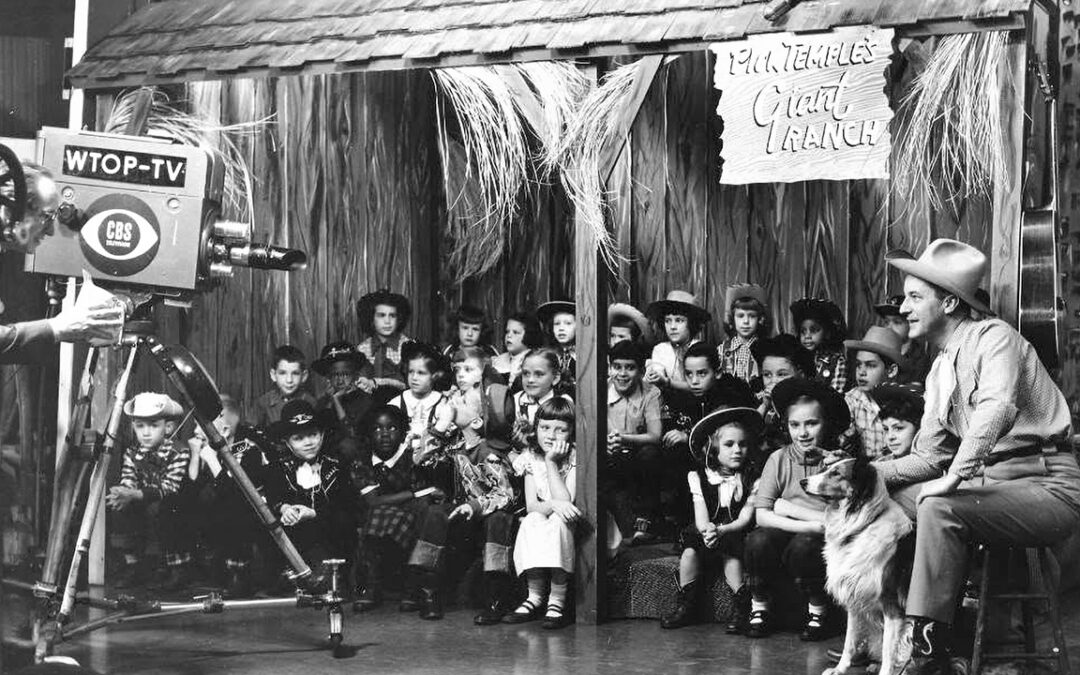
Maybe it was because my birthday was last week, or maybe it’s because Trump and I are close to the same age and were born into the same American culture of George Washington and the cherry tree, and Pick Temple, who hosted a 1950s kids’ show on Washington D.C.’s WTOP-TV.
Or maybe it’s because of the midterms…
Wait a minute, who the hell is Pick Temple? He jumped out of my subconscious from, like, 70 years ago… Yes, it’s the midterms.
When I was about eight or nine years old, my mother signed me up as a possible “Birthday Boy” on The Pick Temple Giant Ranch show.
Mr. Temple was a sort of cowboy god for after-school cowboy and cowgirl third-graders. The half-hour show was like a combination of Mister Rogers and Mister Ed on black-and-white TV.
On TV, Pick Temple appeared to be dressed entirely in white, and he played a lot of guitar. If you were chosen to be a Birthday Boy or Girl, you were singled out and got to ride in the saddle that was positioned on a sawhorse while the William Tell Overture played.
You were allowed to pull your six-guns out of their holsters during the music and fire them wildly at the sky — but there were NO caps allowed, apparently for fire safety.
It was black-and-white TV, but in person Mr. Temple was not dressed in all white like he looked on my TV at home.
He was dressed in light blue from hat to boots, because the studio lights, I was told, would make Mr. Temple “shine too bright on your TV at home.”
This was disturbing, I remember. But it was minor compared to what came next.
When my mother put my name in to be a Birthday Boy, she accidentally wrote down her brother’s birthday instead of mine. While I was being driven to the studio, a shocking thing happened.
My mother told me to lie about my birthday.
I held it together while they sang “Happy Birthday” to me as I sat in the saddle — up until they turned on the music and I pulled out my guns.
Then, as the William Tell Overture blasted over the speakers, I could not tell a lie. I started screaming over and over, “It’s not my birthday! It’s not my birthday!”
The music continued and the chaos grew as people off camera waved their hands, trying to get me to play along. But I had integrity, dammit, as a nine-year-old.
And it got worse. Because I couldn’t get anybody’s attention, I pulled out the guns and started firing, but I had forgotten to take the caps out.
They stopped filming for an instant while they snatched my cap guns, then went right back to filming with the music at full blast.
Before the broadcast, my mother had invited all my friends and their families to sit on our living room floor after school and watch my performance when it aired a week later.
I was worried I would be embarrassed for the rest of my life.
In hindsight, it wasn’t as bad as I thought. They had cut the film and spliced it together so that, in an instant, the William Tell Overture lost track of itself and came back in a different place, and I appeared for the rest of the performance without any guns, my hands at the sides of the saddle, motionless and almost in tears.
My classmates didn’t really catch the interruption, but of course all the adults had been talking about it all week and were laughing hysterically. They left, saying things to my parents like, “Well, he shot the lights out with that one!”
As for those parents, I’m sure they’re all dead. Even the Reflecting Pool has lost its memory in an algae bloom. I hope the truth is restored and the lies end with the midterms, but I suspect not.
Wouldn’t it be great if our leaders had the integrity of George Washington — or, at a bare minimum, a nine-year-old?

by Robert Bowie, Jr. | Aug 4, 2026 | Featured, Personal, Politics
My mother was a political genius responsible for my extremely successful lower school birthday parties but, because of two completely different events, I understand her now.
After my short-lived political career and the opening of the Manor Mill in Monkton, the middle of my political district, I now understand her politics better.
To be honest, my political career wasn’t really a career. It was more like a cosmic failure and horrible awakening. My road to hell was paved with good intentions, but without much political intelligence.
My mother used to say, “At your birthday party you must give your guests something to do before the ice cream and cake and they sing to you.”
As my guests would be dropped off by their parents, my mother would meet the car and usher the child into a pre-party in our yard.
She had everything going at the same time — croquet, dunking for apples, something that had to be blown up so we could all bounce on it and something you could pin the tail on, as well as a small piñata that could be individually beaten to shreds by everybody.
Everybody got to know each other before the party started.
What increased the degree of difficulty for my mother was the times. All these birthdays happened in post-WWII Washington D.C in the late ’50s and early ’60s during the McCarthy hearings and during fears of Cold War communist conspiracy theories, with newspapers featuring articles about the contents and creation of the perfect bomb shelter for under your house.
Even worse, every race, creed, color, and national origin was represented in the fourth, fifth and sixth grades and we had all been instructed that if we ever saw a mushroom cloud during our time together, we should run indoors and put our heads under our desks.
My mother would not approve comparing my birthday parties with someone else’s but here goes:
I went to a classmate’s birthday party — back then but I was dropped off at a movie theater by the birthday boy’s family, who immediately left. We were each handed the cost of admission, popcorn money, and were told we would be picked up at the curb after the movie was over. I didn’t really know any of the other guests. I just sat there in the darken theater and went home afterwards.
The movie we were sent to was called “A Day To Remember” — and believe me, this middle-schooler will never forget.
Stop and think what may have attracted the parents of the birthday boy to this movie. I don’t think they even knew what it was about. Maybe it was the upbeat title.
It was almost two hours and all about the sinking of the Titanic. It was a meticulous, chronological tale of death and drowning delivered in 1950s black-and-white with screaming sound around endless drowning.
The whole thing from beginning to end was about the band playing as the boat went down with missing children and panicked loved ones and near-empty lifeboats.
It has never ended for me.
I got about halfway through it and went into the men’s room to hide in a stall. I would come out about every 15 minutes to peek back into the theater to see if it was over yet so I didn’t miss the pick up after it was finally over.
Only in the last week by contrast, I have come to really understand my mother’s political genius with my birthday parties.
In 2014, after I retired from my law firm and sold my controlling interest to my partners, and decided I would retire, fulfill my duty of public service, and run as a Democrat in the 7th District to turn this world around.
The 7th District, I soon discovered, was a gerrymandered Republican district where all Republicans had been corralled into a single district.
I’ve always been a little naïve and overconfident. The reason I had decided to run for office this late in life was I was committed to making sure that we as a state and country must stop being divided. I made up my mind that I would campaign hard and turn around a gerrymandered Republican district that was pissed off to be gerrymandered. I didn’t blame them. So was I. I spent all that summer knocking doors and raising money to overcome impossible odds.
I lost to a Republican who had accumulated a lot of driving violations, including alcohol, as well as dumping oil in the Chesapeake Bay and trying to run over his mother with his truck.
You lose like that and it’s the end of your political future.
What has made me realize the mistake of my campaign and my mother‘s brilliance is a recent creation in my neighborhood five years ago: the Manor Mill.
Five years ago, Angelo Otterbein bought an old Gris Mill on Monkton Road that had been sold out of bankruptcy and made it a cultural center in the 7th district, the world that I could not penetrate.
It has been a massive cleanup job, but it was Angelo’s commitment to bring it back to is pre-revolutionary luster with its water wheel nearly rebuilt, and the molding cider barrels tossed out. He made up his mind to just open it up to the arts — and all those people that I could not convince to vote for me came and destroyed my caricature of who they were.
There was no politics from the beginning. It was just the creativity of all humankind’s desire to create. I was asked to run an Open Mic Poetry Night. All of a sudden, every place in the mill was full of art from those who had slammed the door on me.
There are beautiful watercolors and oil paintings on the walls, along with stained glass windows. Then came the writer’s workshops, music of all genres in the loft: string quartets, bluegrass, the blues. Beautiful plays are performed on weekend nights.
My caricatures of my voters died when I saw their creativity and we didn’t talk politics and division – we just loved each other’s company.
Angelo somehow understood my mother’s political genius in middle-school birthday parties by trusting the guests and giving them something to do, a place to talk and share opinions, a welcoming place to form community, and eat cake.
My mother was right to let kids have time to play, to not divide everyone ahead of time.
Perhaps we are headed for more chaos with these new midterm elections, but perhaps we are also being given a new chance to wake up to the beauty of our freedom, just by talking and sharing our American lives together.
by Robert Bowie, Jr. | Jun 16, 2026 | Featured, Personal, Travel
Everybody knows there’s nothing worse than a deaf extrovert — except for the deaf extrovert or, worse, perhaps a person trying to learn how to be a deaf extrovert.
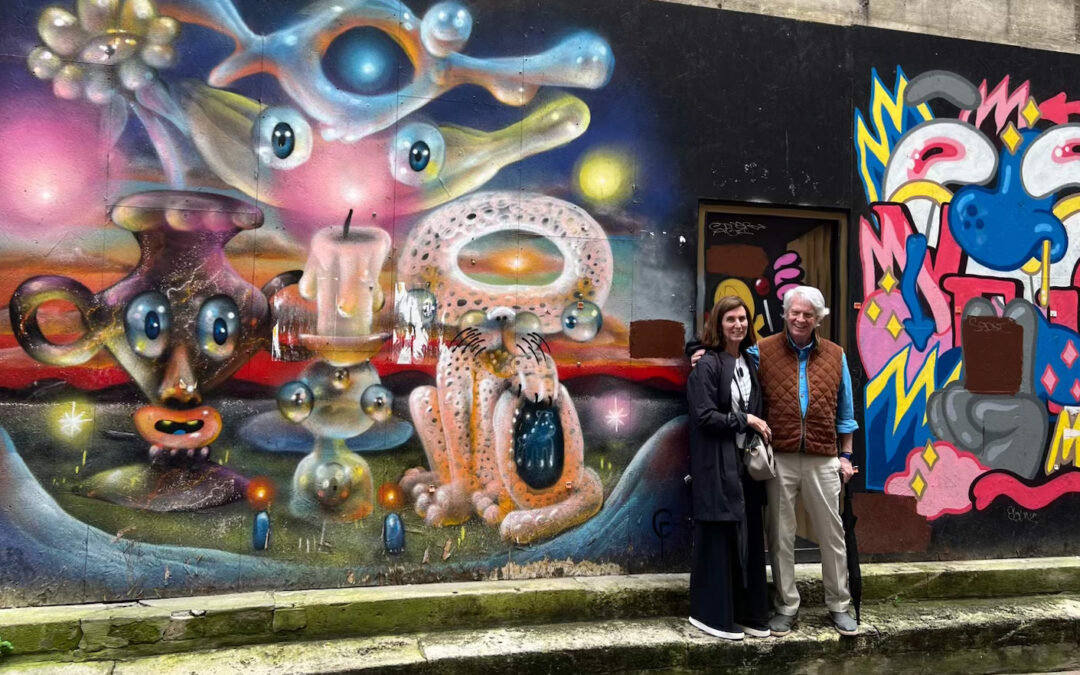
This spring, Susan and I went to the London Book Fair for a week, and to Paris for three weeks in late April.
I am an introvert but I have had to learn to be a deaf extrovert.
Susan and I were invited to a large, loud, and formal restaurant party, where I was seated next to a woman who I could not hear at all. I decided I would ask her questions so she would not ask me questions that I couldn’t hear or answer.
I asked her questions all night and after dinner was over, she went over to my wife and exclaimed to her that I was the most interesting dinner partner she’d ever had.
Such challenges are a gift to those who are growing old and deaf. Everything becomes redefined. It’s just like when you were a kid and looking through spy glasses to bring the distance up close but then you turn it around and everything looks far away.
London was new for us and the book sale hustle brought me back to my work ethic of years ago, but Paris is familiar to us because we have gone each spring for several years.
What is fun is these changes are making me understand the contrast and that contrast has always been there as a metaphor for memory or as familiarity. It’s a little like turning that spy glass around and then thinking about the process of change rather than instantly normalizing it.
The contrast has always been there. But nobody notices because we change everything into normal immediately in our daily lives. We take this contrast and this friction in our life for granted.
The London Book Fair was a predatory hustle. I was provided 30 copies of my book, The Older You Get the Shorter Your Stories Should Be, by my sponsor. I was instructed to selectively give them away to people who visited their booth to promote the book. I was surrounded by posters about the book, which added to the hustle.
I had to learn how to adapt so that I would get the most effective reaction to my gift of a book. I quickly learned to single out my target, interview them and get their card before I gave them my book. Nobody likes a deaf introvert, so you have to get them talking fast about themselves and their interests in books like yours. If I got their card, I could exchange emails with them later without needing to hear them.
In Paris, Susan and I decided to master the Metro. I don’t speak French, so it was easy being deaf. Susan does speak some French so she would break the ice and then, because everyone in Paris can speak English, I would be back to the struggle. The level of concentration needed when you can’t fully hear is exhausting.
But the peace of pure silence once the hearing aids come out is its own reward.
by Robert Bowie, Jr. | May 13, 2026 | Featured, Personal, Politics
Hey, don’t get me wrong, I’m all in on this “Make America Great Again” (as long as it’s the greatness I remember from the late ’60s and early ’70s — right on!).
I saw the people rise up against the Vietnam War and and I saw an American president resign in disgrace rather than be impeached for his cover-up of Watergate.
The people rose up and the government responded and changed. That’s what democracy looked like back then. I was a starry-eyed American and I believed in it completely.
Maybe I still do. That’s the problem.
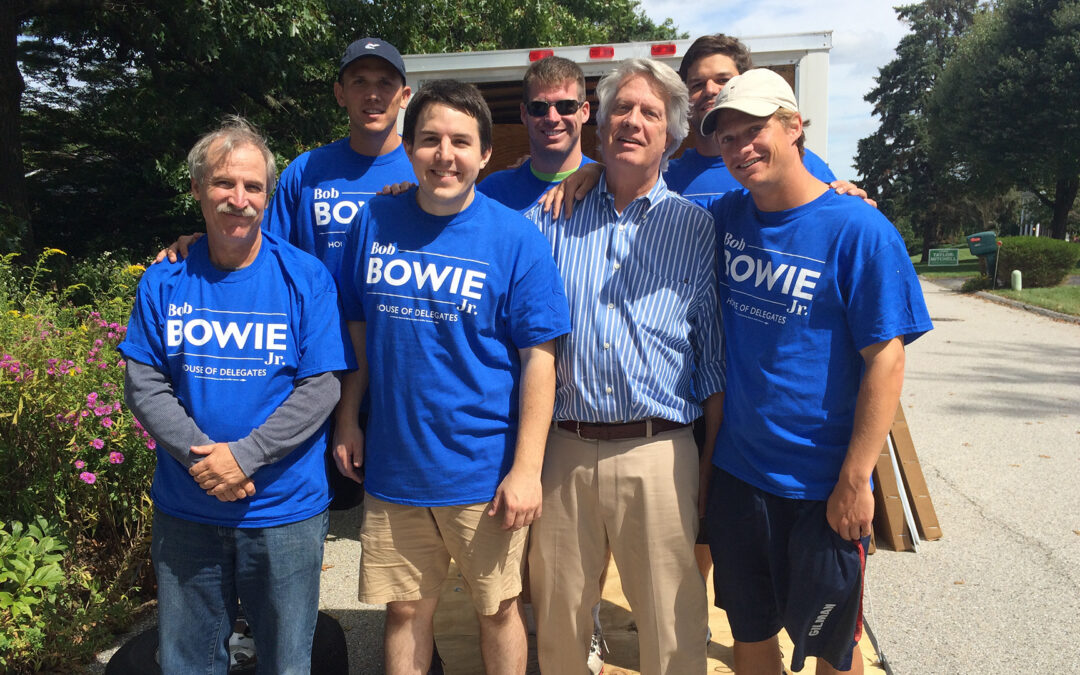
In 2014, the country was becoming more divided and, when I retired from the practice of law, I ran for state delegate in a gerrymandered Republican district — and I got crushed. I developed a sense of humor from the campaign but I am not sure I learned enough from my defeat.
The gravity of it.
When I decided to run for office, I was so naïve. I did not realize that I lived in a gerrymandered Republican district, but I proudly considered it my chance to turn the world around, so I ran anyway.
I knocked on around 5,000 doors and in each case asked, “Have your Republican representatives who have been in office for the last 20 years ever knocked on your door and campaigned for your vote?”
Not a single person said yes.
I thought I had this in the bag! This is about people and ideas, isn’t it?
First, I completely misunderstood what gerrymandering creates. It doesn’t just protect the incumbant. I was food for the angry. I didn’t realize that the oppressed had been herded together to forever hear each other and nobody else.
It is impossible to persuade an echo.
Second, I had no understanding of messaging in the echo world. I sent out over ten glossy cards by mail into neighborhoods where I would be campaigning door-to-door a day or two later and would be the first candidate ever at their door.
Again and again, the trash cans around the neighborhood where I would be campaigning would be filled with my messaging. In my eagerness at one point, I got to one of the neighborhoods on the day the mail was being delivered.
I saw the letter carrier stuff a mailbox and a homeowner come out. He looked at my glossy flyer for just long enough to put it under one arm along with the other unwanted mail, then put it in the trashcan without reading it at all.
In the last week before the voting, My opposition blanketed the district with one flyer and spent the total money they had raised for the three Republican incumbents on that single two-sided mailing.
On one side, it contained horrible pictures of Democrats that I had given money to over the years and, on the other side, they listed the votes that I WOULD HAVE voted for if I had been in office anytime after the Civil War.
Both sides of their flyer were blessed by the same really great picture of me with my eyes shut and mouth open.
A few years later, Trump dominated the news cycle with “fake news” and endless lies about everything.
The times have changed and the culture has too. To put it bluntly, Trump was impeached twice, while Nixon resigned just because of the threat of impeachment.
Door knocking and issues got lost. Political flyers now advertise hate to polarize political parties.
Was I always too stupid to realize we could lose our democracy to tax cuts and dark money — and a First Amendment protecting the nameless who propagate misinformation willfully?
I’m trying to be smarter now than when I was a naïve candidate. If the Democrats win the House and perhaps even the Senate, the nightmare of the midterms may change the Congress, but the Supreme Court is still there. The President’s veto power is intact, and the polarization is not likely to change much, even if Trump is impeached again or disqualified from office.
Trump has made capitalism greedy again. I believed in “Don’t ask what your country can do for you. Ask what you can do for your country.” Let’s make it simple: MAGA: Make America Generous Again.
I still can’t really give up my belief that the midterm will change everything, as long as we can talk to each other and listen to each more than we preach at each other.
The trouble is, I can’t really believe that Trump didn’t bring in the National Guard to the blue states for a reason early in his second term, or has militarized ICE and funded it as his army as it gathers around blue state voting places during the election. I can’t somehow believe that he is not the same person that lead the January 6th attack on the Capital.
I’m still a starry-eyed American. I believe we must make America great again — but we must do it together and Make America Generous Again. That is who we were when we knew we were great.
by Robert Bowie, Jr. | Apr 21, 2026 | Featured, Humor, Personal, Politics
When American politics finally pushes you over the edge, I can save you.
I’ve been there.
Right now it’s even worse than when I ran for office in 2014 in a gerrymandered Republican district.
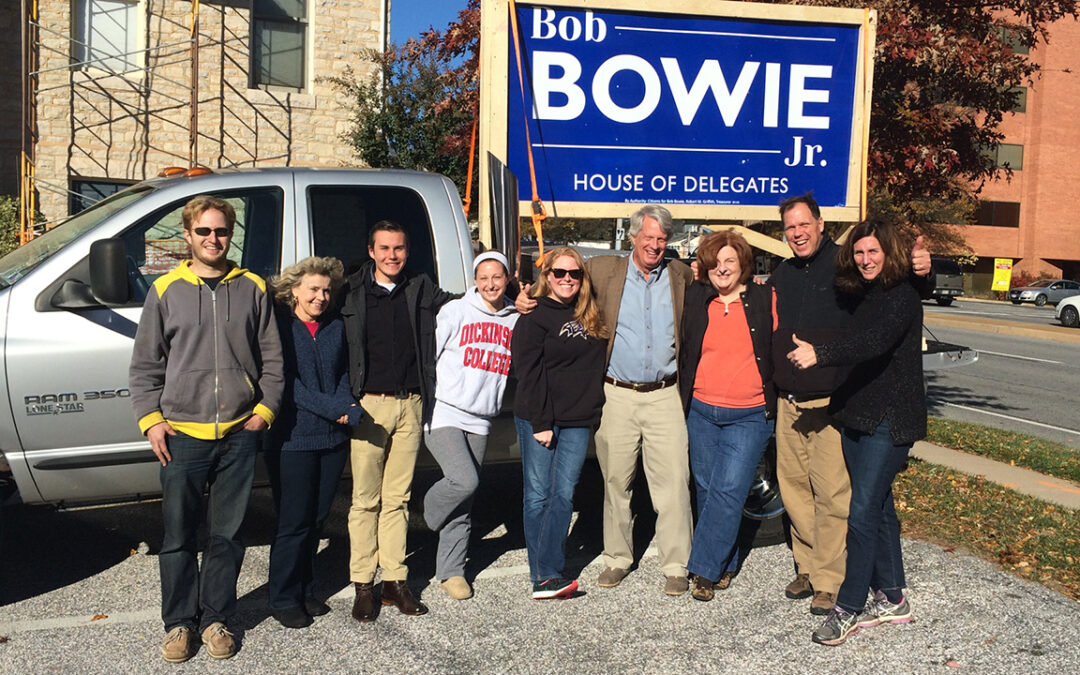
I could feel the country dividing and polarizing, so I decided to run — even though I was told I had little or no chance. Susan, my future wife, along with the two other Democrats in the district, knocked on 5,000 doors and raised $150,000.
I was trying to win one of three seats that had been held by Republicans for a decade. The Republican I was trying to defeat had been convicted of (1) pouring used automobile oil into the Chesapeake Bay, (2) multiple drunk driving offenses, and (3) attempting to run over his mother with his truck. He was recently removed from office for campaign violations — his headquarters were in the wrong district and he was using them as a personal storage shed.
When you lose an election to somebody like that, and you’ve routinely been treated badly while knocking on doors, you’ve effectively ended your political career before it gets started. The alternative is to take up the writing of poetry or the writing of plays, which I have done.
I suffered endless indignities on the campaign trail, some of which I have not recovered from yet.
Like the lady who answered the door in a trailer park wearing a Sunday-morning muumuu. After my pitch, I closed with my signature line: “And if you’re worried about term limits, I’m over 65 — nature will take care of that in my case.”
She paused, contemplated what I had just told her, looked at me, and said, “I’m not sure I can talk to you right now because I don’t have any underwear on.”
I still don’t know what the proper answer to that should have been. She followed it up with “R or D?” When I answered “I’m a fiscally conservative Democrat,” she slammed the door in my face before I could finish with “and I oppose gerrymandering.”
I am still waiting for my Purple Heart from the Democratic Party.
There is only one place where you can regain a healthy consciousness. The answer: extreme shallow water yoga.
I’m sure you can feel my pain even after all these years, because I am now revealing something obviously very precious to me.
It’s a little dangerous, but it’s worth it.
Try it now. The time is right.
When our President is losing a war he started for no good reason other than thinking he could win it in one day — and then sits down to play chess with Iran to (1) negotiate the elimination of a nuclear arsenal he previously claimed he had already destroyed, (2) get terms of settlement that the world, including Russia, China, Iran, and the United States, had already agreed to back in 2015 before he pulled out in 2018, and (3) demonstrates with his first moves that he doesn’t know the rules of checkers, let alone chess — the world suddenly realizes he doesn’t understand, as you do, that every subsequent move plays into checkmate. Iran is playing on his narcissism and lies to turn our allies against us, create inflation at home, and generate an international crisis we’ll be blamed for for years.
You have to start by calming your own mind under the pressure of all this stupidity.
You gotta get a scuba tank and sit at the bottom of a swimming pool until a hand breaks the surface and signals you to come up for lunch.
It works! And here’s why: yoga requires mindful breathing. Underwater, this comes naturally — as you exhale, you’ll hear the bubbles pass your ears, and breathing stays top of mind because if you stop, you’ll drown.
I don’t want to scare you off, so here are some safety tips. Place a lawn chair in the deep end — but skip the safety belts. You want to be able to rise to the surface if you reach a meditative state so powerful you can hear angels singing. Just make sure it’s not nitrogen narcosis. Know the difference.
It is that relaxing.
Instead of a chair, try a pair of boxer shorts with huge pockets and one of those rip-away jerseys football players wear so they can’t be tackled. Fill both with lead. You can then disrobe underwater and easily return to the surface — the pants and shirt rip off instantly as you rush for air.
As a worst-case scenario, you can hold barbells in both hands. Fair warning: jumping into a pool with large barbells tends to create massive waves that break outside the pool, and even jumping in feet-first, the barbells will likely send you headfirst to the bottom at speed. That said, barbells do eliminate any shirt problems, and you can simply let go if you lose consciousness while reaching Nirvana — or if you start confusing inner peace with nitrogen narcosis, and the angels calling you from the deep-end drain start sounding a little too compelling.
A final note of caution: check with your insurance company, as there may be no coverage if you die.
Of course, I could be wrong. Trump seems very confident. After all, he’s been debating the Pope and has posted portraits of himself as Jesus on Truth Social.

by Robert Bowie, Jr. | Mar 31, 2026 | Featured, Humor, Law, Personal, Politics
Over the last month, I have tried to understand what it feels like to be a real coward. Not just an everyday coward who lacks courage or is very fearful or timid, not even a lily-livered coward.
I have tried to understand what it must feel like to be a Republican elected to the US Congress, who willingly lives under the thumb of Donald Trump.
I’m trying to figure out how it must feel to be elected to Congress, take an oath to uphold the Constitution, be paid by the taxpayers a salary along with benefits and privileges that are better than what their constituents get, and then abandon your singular responsibility to determine if the country should go to war when “there is no present danger.”
This is as close as I could get:
In my third year of law school, we were allowed to practice law in a clinic run by Professor Michael Millemann. For my first case, I was given a letter from an inmate at Perkins, a prison in Maryland that the legislature had endowed with indeterminant sentences.
An indeterminant sentence meant that when a prisoner had conformed his behavior to the standards acceptable to the outside world, according to a prison psychiatrist, he would be released.
The indeterminant sentence, however, had backfired because there were petty criminals like shoplifters or road rage drivers who had been given short sentences originally but had not convinced the system and thus remained in Perkins for years.
The letter was from an inmate we’ll call Rocky. It was short and sweet. It said: “GET ME THE FUCK OUT OF HERE.”
I had never been inside a prison before, but I had to visit Rocky at Perkins to discover any facts that I could use to “get [him] the fuck out of here.”
I waited in the waiting room with the echoing sounds of slamming prison doors along with all the other endless prison noises. There is nothing to absorb the sound. It is loud all the time.
Three sets of clanging doors opened and shut behind me as I was escorted through a maze of corridors to get to a small room with a low ceiling and no windows. Prison bars filled one wall, with a seat for the inmate on the other side and a folding chair and narrow desk held in place in front of the bars for the lawyer to take notes. When the prisoner and the lawyer were facing each other on opposite sides of the bars, they were probably no more than three feet from each other.
One of the prison guards sat outside of the door and, after a short pause with all the prison sounds echoing around me, Rocky made his appearance at the far end of the corridor.
As he walked toward me, I could see he was about five foot six, wearing prison pants and a sweatshirt cut off to show his shoulders and well developed chest and arms, which were complete with spider tattoos. He wore a red bandanna tied around his head.
What struck me first was his unyielding Charles Manson eyes.
Before he introduced himself and sat down in front of me, he addressed the prison guard with a hostile voice, “Hey, you fuck’n dick, get lost. I’m talking to my lawyer!”
The guard picked up his chair and immediately left me a little uncomfortable. Rocky then looked me over and said, “How fuckin’ old are you?” He didn’t wait for an answer. He sat down and continued, “I killed two people. How am I gonna conform to fit into society? Get me out of here!”
“Rocky,” I said with the calmest voice I could muster. “I’m here to listen to your story and do everything I can to get you what you want.”
“What don’t you understand? I can’t be here anymore. This fucking la la place is ruining my reputation in the outside world.”
I’m pretty sure that my hands were both shaking as I tried to take notes on my yellow pad. He told me that it was a dirty drug deal that went bad and that he had punched one guy to death. “I shot the other one with his gun. How do I conform? Bring ’em back? I want you to get me out of here! Do you understand?”
I kept asking thoughtful questions in an effort to look mature but, when I read my notes later, they didn’t make any sense.
I closed the interview by asking him what he really wanted, other than to get out of this place. He replied, ”What the fuck is wrong with you? I want to go to a maximum security prison where I should be. This la la land is wasting my time!” What’s so hard to figure out about that?”
“I got it, Rocky. I got it.“ I tried to smile confidently and failed. “Don’t bullshit me, boy,” he replied. “You’re not wasting my time, are you? Are you gonna get this done? I got friends on the outside who will be watching you. You understand?”
As if he was sealing the deal, he shoved his right hand between the bars to shake my hand, and I instantly flew backward against the wall as the folding chair collapsed beneath me.
He looked at me while I was lying there, shook his head and said. “You’re doing this, okay?” He turned around and screamed for the guard: “Hey, dick, we’re finished!“ As the guard approached, he turned to address me again: “We understand each other?” I replied in my deepest possible voice as I reassembled the chair: ”Yeah, Rocky. I’ve got you covered. We got a deal.”
My normal heartbeat returned about four days later.
At the end of the semester, the legislature voted to close Perkins and the governor had signed the bill into law and the prison system was sending its inmates to serve out their prescribed sentences in other prisons throughout Maryland.
I had nothing to do with the legislature’s termination of Perkins but I checked every day to determine when Rocky would be sent to serve out his life sentence at the Cut, which was a maximum security prison.
In fact, I had followed the process closely and had dreamed about Rocky throughout the semester.
After he was transferred to the Cut, I sent Rocky a copy of the bill that the legislature passed and the governor signed with a personal note: ”Rocky, Good luck at the Cut. It has a reputation as the harshest maximum security prison in Maryland to serve out the remainder of your life sentence. Best wishes, your friend, Bob.”
Looking back, I will admit I was a run-of-the-mill lily-livered coward but I’m still unsuccessful in determining what it must feel like to be one of those Republican congressional cowards.
Maybe we should reopen Perkins so they can stay for free until they can conform to the minimum standards for upholding their duties to the country and the Constitution.

by Robert Bowie, Jr. | Feb 12, 2026 | Featured, Personal, Politics
I know exactly why America hasn’t risen up together — Democrats, Republicans, and Independents — to protect our midterms and our country. It’s all based on my personal experience as a middle school ice hockey goalie.
I played hockey goalie before face masks were used, back in sixth grade. I was fearless. Bad stuff happened to other people, not me.
The best game I ever played was the first game I ever played, because the sixth graders could barely skate, and most importantly they hadn’t learned how to lift the puck.
I had a simple strategy: When they would skate toward me, I would drop down to my knees and lie down, because if I lay down I could cover the entire face of the goal and most importantly the people trying to score on me couldn’t lift the puck over me. All I had to do was lie down and think bad things happened to other people.
It never occurred to me that lying there with the ice at eye level I could have taken a puck to the face.
My hero was Jacques Plante, the goalie for the Montréal Canadiens. No goalies back then wore face masks. I saw a picture of Plante in a National Geographic about Canada. His face looked like a spider’s web of scars.
In the winter of my sixth-grade year before our first game, I was invited to a birthday party to watch the Boston Bruins play the Montreal Canadiens and Jacques Plante took a puck to the head.
The Canadiens trainer skated out to Plante with a towel to stop the bleeding above his left eye, then guided him off to the dressing room to get stitched up.
The organ played as they mopped up the blood on the ice in front of the goal and we waited for his return. He showed no pain. He was tough and brave. Nobody ever envisioned that anything would ever change.
Early the next season, the coach handed me a flesh-colored plastic face mask. The seventh graders could now lift the puck and they had developed super fast slap shots.
That night I took the mask up to my room and put it on. It fit nice, snug and tight, but then everything changed.
I found a hockey puck and put on the mask and put the puck into the holes for my eyes and felt my eyeball pushed back into its socket. It fit like a key in a lock. I imagined the power at impact of a slap shot into my eyeball. It became real and a shiver went through me.
Even though I had never thought of it before, I started thinking seriously about basketball or, god-forbid, wrestling.
That’s us right now. That’s America. We’ve been lying flat on the ice, telling ourselves bad things happen to other people.
Why did we not rise up together when Trump sent the National Guard into LA and other blue-state cities? When he sent masked ICE agents to arrest just about anybody who is not white under the Kavanaugh doctrine? When ICE was told they had immunity from prosecution for illegal excessive force? When Trump and his administration argued away the two killings by ICE of American citizens in Minnesota, despite contrary video evidence? When Trump and the Republicans voted for $83 billion to fund ICE when $6 billion a few years ago was enough?
More and more it’s looking like ICE is becoming Trump’s masked private army. What if ICE is standing at every voting station?
Why did we not rise up together when Jack Smith recently testified that his investigation found “beyond a reasonable doubt” that Trump himself led the insurrection on January 6 — and has continued to campaign on “Stop the Steal,” even though he lost 61 court cases and won none, and has given all the insurrectionists pardons? You don’t think he might try it again if he has the funding?
Why did we not rise up together when it was reported that he increased his net worth in the first year of his four-year term by over $4 billion at the country’s expense?
We’ve been watching the blood get mopped up in front of the goal and waiting for normal to return.
T.S. Eliot wrote that “humankind cannot bear very much reality.” Reality is all around us as the midterms approach. Jacques Plante’s blood in front of the goal as he’s being stitched up becomes personal.
Once you wake up your mind, everything is real when you are terrified.
I think we’re gonna be OK for the midterms, if everybody who can vote gets so frightened that they show up at the polls — mutually aware of their danger and sharing it — and refuses to leave until they vote. If we are united, we will be OK. United, we will be the real America that we are — the United States, not the Divided States of America.
Imagine your life and the life of all the people you care about if we lose the House and the Senate, with the Supreme Court offering no check to executive power. Imagine the puck going through the keyhole of that mask into your eye socket, the pain and the darkness.
Wake up. Be terrified. Bad things happen to everyone if we don’t stop lying flat on the ice.

by Robert Bowie, Jr. | Jan 27, 2026 | Featured, Law, Personal, Politics
As our country has become more and more divided over the last 10 years, I go back to this little story from a long time ago.
Back when I was practicing law, I was hired to represent a brokerage firm that sold huge airplanes. The firm believed it had been deprived of a commission by the Christian Broadcast Network (CBN), in particular Pat Robertson, who had just run for president.
I arranged a deposition of Mr. Robertson at CBN’s corporate offices in Virginia. The offices were opulent. When I entered, several TVs in the waiting room all showed the same image: Pat Robertson, raising money.
I was kept waiting for over half an hour, and I realized that I would know when the deposition would start when Robertson was no longer on TV and had let somebody else continue the fundraising.
Eventually, I was ushered into a large conference room where the court reporter had already set up. The lawyer representing Robertson and CBN was about ten years out of law school and a sole practitioner. He stood and warmly greeted me as I entered the room.
When Robertson entered, everything changed. My first impression of Reverend Robertson was his extremely elegant bejeweled cowboy boots. All of a sudden, I was in a war room with everyone but me standing at attention.
My impression was confirmed when I asked the court reporter to swear in the witness. The court reporter immediately turned to Robertson and said, “do you prefer to ‘swear’ or ‘affirm?”
I’m still not sure what the difference is, but I insisted he be sworn in and, of course, his lawyer came over the table at me. I fully expected this to be a contentious proceeding, but this seemed a little ridiculous nonetheless. He was in battle mode.
I started out asking whether the airplane that had been purchased had been used for political trafficking, which would, if Robertson admitted it, have put the tax exempt status of his religious organization at risk. Robertson refused to answer the question and of course his lawyer again came across the table at me.
This is not unusual behavior for a young lawyer, particularly if he happens to be representing an instrument of God in southern Virginia. We could not have been more different, but somehow I liked his youthful, pugnacious representation.
I was pretty happy with the deposition. I got everything except that question about the political use of the airplane. (My prior research had revealed that, in fact, my assertion was true.) Robertson had been forthright with his other answers and over the next two hours his lawyer demonstrated nonstop hostility toward me, showing off to Robertson.
At the end, I told them I would be scheduling a conference call with our federal judge to see if my question should be answered. It was a close call whether it was even relevant but the stakes were high for them, and I respected the young man for his tenacity.
When it was over and I was headed back to the parking lot, I was surprised to feel a tap on my shoulder. It was the young lawyer who had been representing Robertson. He was a different person now, returning to the person who warmly welcomed me before Robertson arrived. He invited me to have a drink with him and join him for dinner not far away in Virginia Beach, to go see his favorite zydeco-band, The Subdudes.
Over the rest of the evening he couldn’t have been friendlier. He had gone to a local Christian law school and was looking for work for several months before so he went to a Christian retreat, where he claimed he got this client because he was extremely good at “speaking in tongues.” As we talked, I was convinced that his Christianity was real, even though his marketing strategies were suspect. Anyway, The Subdudes were great and the beer was cold. I bought their CD. He refused my offer to buy him dinner because he said it was a conflict of interest, which I guess meant he thought I was Satan.
Although we were from different worlds, he introduced me to his music as an act of kindness, and perhaps because of the beers we drank, we laughed, asked each other lots of questions about our entirely different lives, avoided conflict, and opened up to each other.
About a month later, the federal judge’s video conference call was scheduled and the case was diplomatically settled.
I never saw him again, but we shared our lives for a short time and the supreme polarization and differences disappeared.
In the end, I think it was because we shared what we both liked: the music and, eventually, each other’s company. We could not have been more politically different. Maybe it was the beer, but I thanked him for a fun evening and actually commented on how different he appeared from when we first met. He smiled and shook my hand and said, “We’re not that different. We’re Americans having fun.”
If we all really want to fix this country’s polarization we should ask each other real questions and not preach to our chosen choir. You might find common ground and make a friend.
You might even get a good CD out of it.
by Robert Bowie, Jr. | Nov 12, 2025 | Featured, Personal, Travel
There is nothing sadder than the moment that you realize you have missed the chance for an apology or an “I love you” that can’t be delivered because it’s too late.
At the end of my recent guided trip to Savannah, Georgia and Charleston, South Carolina I had back-to-back realizations of long-lost opportunities to apologize and to say “I love you.”
I have previously written about the trip that my friends and I took a year and a half ago to witness the history of the nonviolent practices of Martin Luther King, Jr. and the effort to enforce the civil rights laws in the western part of the south.
The focus of this trip was to follow the American slave trade pretty much from its beginning at two of the entry points and places between — from its beginnings to its end. It was a powerful experience and an amazing trip because it shook me to my roots and changed my understanding.
There are people who pass through your life and then before you can truly understand the dignity of their life and the kindness which they showed you before they are gone. In my case, one was Florine and the other was Jane. Both were Black women.
There is a fair amount of written material that documents the slave trade in America but it only becomes real when you are standing in a slave cell in which human beings were held for extended periods of time before they were auctioned into slavery, and after they had withstood the travel, in which 20% of the cargo are lost by the end of that journey.
Ten percent died on the ship and the other 10% were the unruly who couldn’t be sold. Sharks followed these ships across the waters to their destination.
As usual, I had read the dates and about the places, but to walk into slave quarters or visit buildings which have been inhabited during whippings, and experience the culture of slavery made it all real for the first time.
Slave women were forced to be kept pregnant, because they were producing product and this product was valuable. When they were old enough, the children would be sold and be lost forever. At birth, they were given only a first name no last name. After emancipation, they often just assumed the last name of their owners.
Chewing cotton roots was known to be an abortive for female slaves who did not want to bring their children into a world of degradation, however, if a pregnant slave was caught chewing cotton roots, they would receive 36 lashes, which is an unthinkably cruel punishment, especially for a pregnant woman.
Whipping was also administered to punish both slaves and their educators if it was discovered that a slave was being taught to read or write or learned mathematics such as the multiplication tables.
Florine Burk took care of my little brother and I in the late 1950s when we were kids in Washington, DC. She was a heavyset African-American woman in her 50s who had grown up in the South and had gotten her education in a single room school.
She was a force.
She could sing the alphabet and the multiplication tables. She was an avid reader who never spoke about her politics but you could feel by her presence what she thought.
She loved and knew a whole lot about Jackie Robinson and the Brooklyn Dodgers. My brother and I were required to memorize and recite the lineup for the Brooklyn Dodgers.
My brother and I loved her. She would hoist up her skirts and hit long fly balls in the backyard. If my brother or I hit a ball over the fence and through a neighbors window, she took our hand, walked us around the block, got us to knock on the door, made us promise that we would fix the window, and then she took us out to buy the glass and the caulking, and we would put in the window as she watched.
Eventually, we asked her to take us to a Washington Senators baseball game. She refused, and there was no doubt we were never gonna go with her to a Washington Senators baseball game.
Her reason, she said, was that Washington was “first in war, first in peace, and last in the American League.” She said she did not want us to witness bad baseball.
It was the 1950s, but it wasn’t her real reason and you could feel it, but I didn’t know what the real reason was until the last day of our recent trip.
Some things you have to learn late in life, and this trip taught me to look deeper into for Florine’s logic.
The morning before the end of the trip, I went online and researched the Washington Senators and found that they were one of the last teams in baseball to ever hire an African-American. They had drafted a black Cuban pitcher and identified him only as Cuban.
Florine knew her stuff. But this trip made me realize that I did not understand the depth of her character or what life must have felt like to her as a domestic raising white children in a brutally segregated city.
After she retired, she went to Los Angeles to be with family there. My brother and I wrote her birthday cards each year and sent her Christmas cards. After a few years, they would be returned to us unopened. I never told her face-to-face how much we loved her and respected her before she died.
That morning, I also realized the pain of a court clerk at the first trial I ever did in the Circuit Court of Baltimore City. I had been told that if you don’t know the judge or what to expect in the courtroom the first thing you do after you unpack is talk to the court clerk and try to make friends.
The court clerk was an entirely professional Black middle-aged woman who shook my hand and welcomed me to the courtroom when I offered my name and explained why I was there.
I put out my hand and said “I am Bob Bowie. What is your name?” She replied, “My name is Jane Bowie.”
She was instructive throughout the case and helped me when I asked my naïve questions. After the trial, I went over and thanked her and said how much I appreciated that we both had the same last name, and I had “a family friend in the court.” She smiled and laughed and patted me on the shoulder.
Over the next few years, I would see her on the streets around the courthouse and we would stop and talk. We became friends.
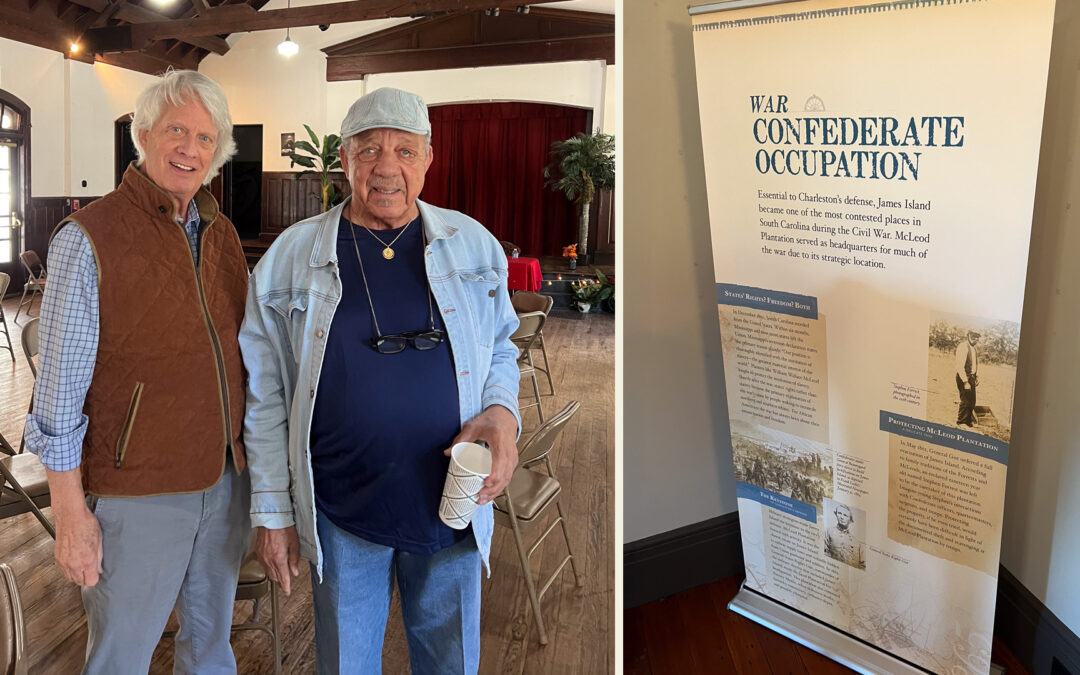
On this trip to South Carolina, we went to a museum that had only people‘s first names engraved in the walls at the entry room. I asked why were there only first names and the guide politely said during slavery, there were no last names, only afterward did many of the slaves just pick up the last name of the slave holder.
My family owned slaves in Prince Georges County. Much to my horror, I realized that Jane Bowie most likely came from an enslaved family that my family may have owned.
I was stunned and ashamed, but then I realized, and deeply respected, the kindness that she had offered me in the face of this country’s white supremacist history. Jane, like Florine, vanished 20 years ago and I never had the chance to recognize what she knew and the courage she had in dealing with me.
I fear that even in this generation, our children will look back and wonder how we could have looked the other way when immigrants came to this country and, as punishment, they were separated from their children when all they wanted was a chance to be free to raise them.
If you’ve ever had a blood transfusion, you never know whose blood it was. It was given as a gift from one human being to provide life for another. It’s a reminder of our common humanity, but we never quite live up to the obvious.
by Robert Bowie, Jr. | Oct 21, 2025 | Featured, Personal, Politics, Travel
This past weekend, I was reminded of this excerpt from my book, “The Older You Get the Shorter Your Stories Should Be” (page 169):
As the lions slowly approach, my fellow riders in the safari jeep become either “believers” that the jeep is safe territory or “nonbelievers” who, with every step of the lions, seem to be counting down the last seconds of their lives. They can’t move and the fear becomes palpable. The eyes are wide and the breathing becomes slightly labored.
On the other hand, the believers are happily photographing and silently adjusting their telescopic lenses. The lions grow closer and closer and, within 10 feet, three veer to the right and one veers to the left so that it will be behind us. Everyone in the jeep recognizes that they must keep their eyes on the three lions that will pass to our left within several feet of the jeep, but we will not be able to turn and watch the one lion that is moving behind us on our right.
The believers continue to happily photograph adjusting their telescopic lens to catch the reflection of the jeep in a lion’s eyes. The nonbelievers are breathing softly, their eyes closed, waiting for death.
After a few moments they were past us and we started the engine and continued our day.
(You can find the book on amazon or support local bookstores at bookshop.org.)
