by Robert Bowie, Jr. | Jun 17, 2025 | Featured, General, Humor, Law, Personal, Politics
When I started to practice law, Jimmy Carter was elected president. To avoid some unimaginable conflict of interest, he sold his family farm for peanuts. Since I retired from the practice of law 10 years ago, apparently the ethics have changed.
President Trump for his birthday last week gave himself a military parade, which which cost the American taxpayers approximately $25 million and tore up the streets of Washington.
Several news services have recently reported that since the early days of President Trump‘s reelection campaign he has made more than double his net worth, about $5.4 billion dollars.
In the past, I would’ve been horrified, but now my reaction is that it’s a shame I didn’t somehow make a bigger profit back when ethics prohibited me.
Back during those ethical times I would preach to the lawyers at my firm that the easiest way to check your professional ethics is to ask yourself if what you were about to do would be embarrassing if it would become a headline in the New York Times. If so, don’t do it.
President Trump has re-organized and turned upside down the professional ethics of the presidency and the ethics I was used to. Everything unethical or untrue that Trump has done now is routinely front page headlines on the New York Times, which nobody reads anymore.
I have gone back to thinking about how rich I would be if I’d taken on cases that I ultimately rejected long ago because of ethical concerns.
Consider the amount of money I could’ve made if I had taken that case long ago of two Hindu businessmen who came into the office and told me they wanted to incorporate (for personal liability reasons) an ongoing business that provided Hindu Americans a chance to bury their families in the Ganges River for about $5,000 per loved one.
They told me that the contract that they offered guaranteed that the loved ones ashes, with which they were entrusted, would be respectfully sent to the Ganges, a boat would be hired as well as a videographer to make a movie of the ceremony as the ashes were transported in a beautiful urn, and a man rowing the boat out in the Ganges would be filmed opening the container and emptying it so the ashes were visible as they were were gently poured into the river.
The $5,000 would be collected in exchange for the video of the ceremony.
I will admit I was intrigued by this novel, religious practice and I asked about the heavy cost of the procedure and the profit they were making per contract.
Without batting an eye both businessmen looked at me and said it was about 95% profit. I asked them how could they possibly make such a profit and they answered: “We send everyone the same video.”
If you’re using the same video and you are making a 95% profit you certainly don’t have to be greedy. You could include a beautiful hologram of the soul rising from the Ganges and fluttering off into reincarnation.
Also they completely missed the opportunity for relics, swag, and real cool T-shirts.
When you include the total Trump’s family and political friends have made in the “pay to play” access and favors, which have included the opportunity to show your personal love and respect by purchasing Trump bitcoin and Trump Bibles, and such gifts as an airplane from the government of Qatar, no wonder Trump wants a third term.
I was so stupid I refused to represent the two Hindu businessmen, even though they generously offered me a free burial in the Ganges.
I could also have befriended the President by referring him to another client who I rejected. For a while, “viatical contracts” were easy money. Several people had the idea at the same time. During the AIDS epidemic several entrepreneurs were going into hospitals or hospices and offering to buy life insurance policies at about 10% of their face value from those who would soon die. There’s nothing illegal about that, but for me it didn’t pass the smell test.
There is some justice in the world. Once effective HIV treatment became available, they were stuck continually paying for ongoing life insurance policies.
I suspect that the Trump family has already seen the future of medical profit as is evident from the appointment of Robert Kennedy, Jr. and the future of TMD (Trump Measles Deterrent). This is not a vaccine. it is free and called “The Trump Blessing,” which is administered over a Zoom call after you buy some of the remaining overstocked Bibles that will become collectors items soon.
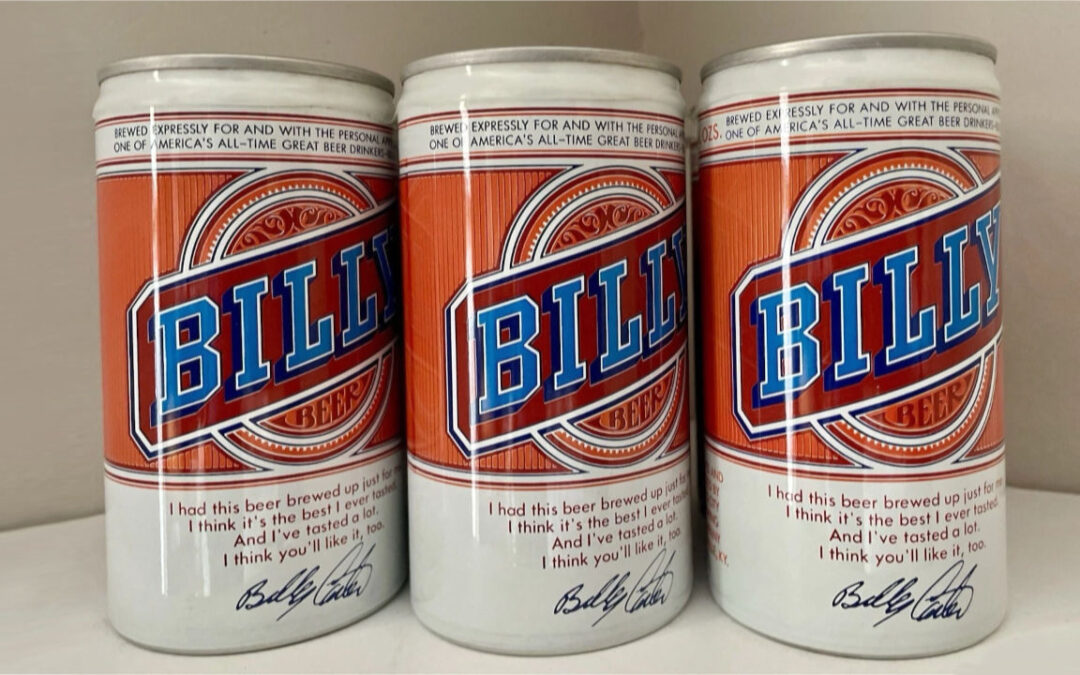
I think the only benefit Jimmy Carter received from his presidency was a gift given by his brother: a couple of cans of Billy Beer.
by Robert Bowie, Jr. | May 27, 2025 | Featured, Humor, Personal
Have you been following the economics of this country recently?
Guess who was invited to President Trump’s private event for customers of his cryptocurrency business on Thursday and given a White House tour on Friday?
I wasn’t!
I called my friends, Peter, Belinda and Liza, to see if they had been part of this same oversight by the President.
Peter, Belinda and Liza and I were neighbors during our middle school years and have been friends ever since for over 60 years, and all of us were there from the beginning of cryptocurrency.
They weren’t invited either!
We concluded that this oversight by the President was not his fault and was due to only one possible interpretation.
Our President does not know a lot of American history or, to be a little more polite, he has not yet become aware of the true history of cryptocurrency.
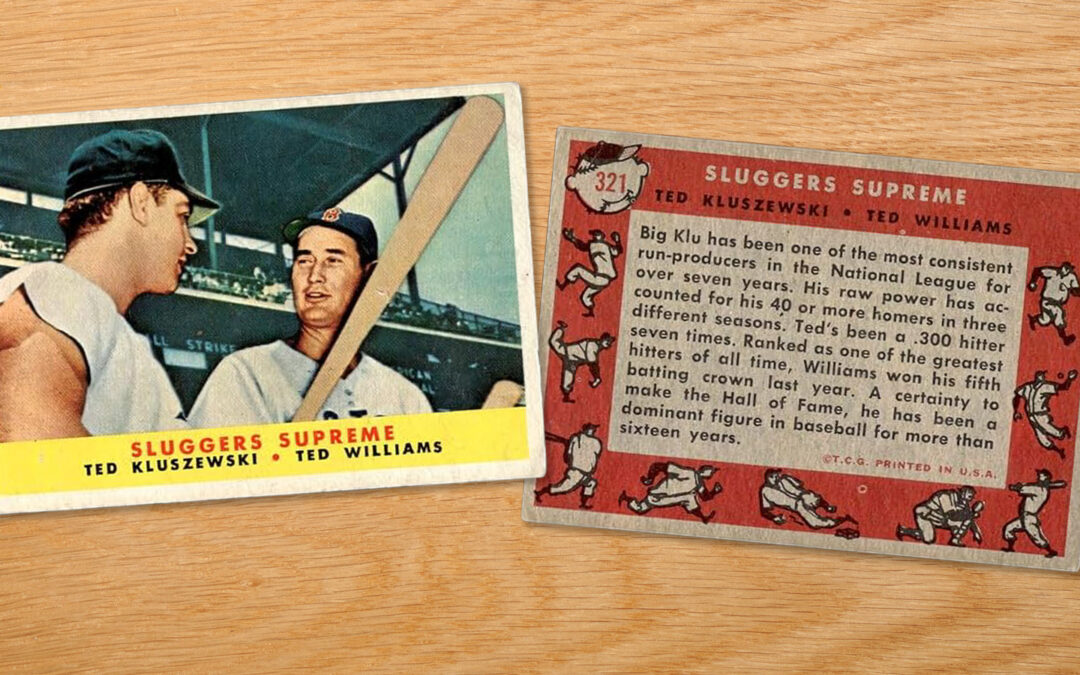
As the rest of us already know, cryptocurrency was quietly created after Nixon took the country off the gold standard. Quite conveniently, it was the same time the first Topps baseball cards were issued in five-card packs with a card size slab of bubblegum included.
The retail cost was five cents per pack. A penny for each card and the bubblegum was free — age appropriate pre-pubescent genius marketing.
A half century before cryptocurrency entered the world stock market, Peter and I were both early investors in baseball cards, and then found another lucrative market in marble monopolies. We were early traders in pre-crypto middle school cards and marbles during recess.
Peter cornered the marble market so effectively that the marble market collapsed after he won all the marbles.
I tried to make a run on “big marbles” so I dressed up my little middle school self and went to pawn shops and antique stores looking for clear round door knobs.
Regrettably, no door knobs are completely round and thus valueless in the larger marble markets.
As a result — for the good of the market — Peter gave a written announcement handed out to the neighborhood that he would be emptying several boxes of marbles to the neighborhood market for free one late spring Saturday afternoon. It happened out of a second floor window with the driveway below. It was an early example of flooding the market.
Peter emptied five bankers boxes of multi currency marbles, including “puresy boulders” and several stunning “jumbo spirals.” The market was saved and Peter had made recess fun again.
Baseball cards back then were “to die for,” particularly if you had a complete set. Peter had a complete set of baseball cards for the years 1957, 1958, and 1959.
Even in middle school, you knew these people were serious people! Peter was a born collector and became a well known New York art dealer. Liza became a respected museum curator in Washington DC, and Belinda became a brilliant art writer and critic.
In the alternative, when I went off to college, my mother emptied my closets and threw away all of my marbles and baseball cards… and I became a lawyer.
At the same time as Trump’s cryptocurrency banquet and tour of the White House, his administration announced that they would be retiring the penny because it was not cost-effective to produce it anymore. They had determined that it took four cents to produce a penny. Think about the appreciated value of just one card, bought for a penny. Or even better, a complete set.
Ever since Nixon took us off the gold standard, our currency, stocks and bonds, like cryptocurrency, have no value other than the theoretical value according to the market.
However, with marbles and baseball cards, unlike cryptocurrency, there is the added component of artistic beauty. They are self valuing and hold a valuable historical record on the flip side of the picture — batting average and stolen bases and other stats.
Also, the bubble gum is great for the dental economy.
Hold onto your baseball cards and don’t lose your marbles!
by Robert Bowie, Jr. | May 20, 2025 | Featured, Personal, Travel
When Susan and I flew to Paris again this year for three weeks this spring, I had planned to watch the Bob Dylan movie, “A Complete Unknown” on the flight that night, but I was too tired so I slept instead.
Paris was warming to its spring as we landed at Charles De Gaul airport and traveled into the heart of Paris to a beautiful flat with its view of the Seine from its fifth floor living room and bedroom windows on the Île Saint-Louis.
The six hour difference in the time between the East Coast of the United States and Paris delayed the news reports that poured into my cell phone at three in the afternoon Paris time as America woke up and went to work.
The distance and the time change diminished my obsession to keep up with America’s politics, but nothing could uncouple it from my daily concerns.
Over our three weeks, Susan and I committed to walk the city, but for longer trips to Montmartre or the outskirts of Paris to the Louis Vuitton Museum to see the huge new David Hockney exhibit, we took the Metro.
Each evening, we would go to one of the little restaurants on Île Saint-Louis and then climb the stairs or take the little elevator to the flat to read the news before bed.
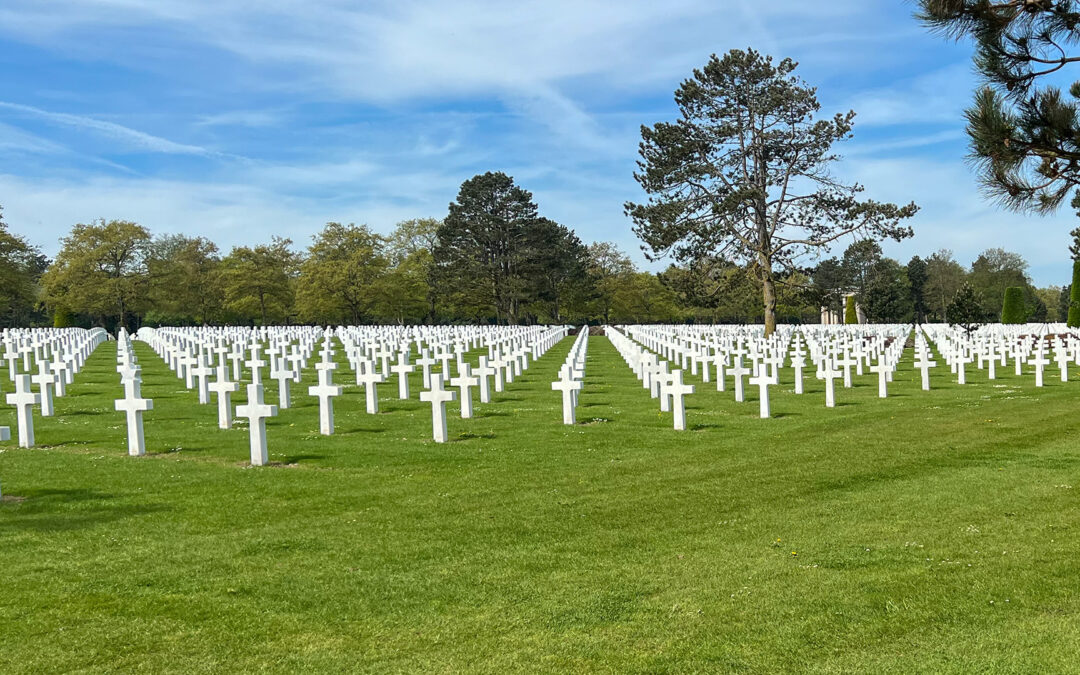
Last year. we had taken three days off from Paris to go to the LaVar Valley to stay in a beautiful Château and visit the region’s medieval history. This year, we went to Normandy and, as I observed the beaches and cliffs, and finally the dramatic American cemetery, the pride I’ve always felt for America rekindled with my respect.
On the morning that we flew back in mid May, Paris was in full bloom as we got on the plane to fly into the upcoming day on our return to the United States.
I again committed to watch the Bob Dylan movie on our way home.
Even though it had been out for some time, I still had not seen it, but I knew enough from the reviews that it was about the transition from Dylan’s early folk years to the electric folk rock that Dylan made in 1965.
In the fall of 1965, I had started my first year at the Cambridge School of Weston, a progressive high school that knew something about learning disorders and thus was unlike the boarding schools and summer schools I had attended previously.
It was my second try at 11th grade. My new school was so very different in so many ways, but as my classmates wore sandals and blue jeans and played guitars out on the quad or went off to the ceramic studio and the wide range of classes offered, I attended my classes in a sport jacket, but eventually gave up on the tie.
I believed I was in transition to a better place and I believed that from the start. I was hoping that repeating the 11th grade would rekindle my love of learning in a new environment with a fresh start.
Within weeks of my first day, a sign-up sheet went up in the dining room, which offered tickets and a bus ride provided by the school to see Bob Dylan play in a Boston theater.
I signed up with about 15 of my fellow students and we got on a little bus to go down to the theater.
When we got to the venue in downtown Boston, we were told that it had been sold out almost immediately and, though we had paid for our tickets, no seats had been assigned for us.
The theater instantly took action and placed folding chairs in a semicircle on stage directly behind Bob Dylan.
The first half of the performance was all Bob Dylan singing his folk songs in front of an adoring audience with us directly behind him.
When the audience returned to their seats for the second half of the program, however, a rock ’n’ roll band was now set up to back up Dylan. We pushed our seats back further to accommodate the instruments and cables.
When Dylan entered, he was met with catcalls. I could not believe what was happening in front of me. I sat, self-conscious and a little bit frightened, as Dylan faced the catcalling audience.
Dylan played the first few songs with the electrical back up in the midst of the continuing catcalls.
Somewhere in the middle of one of those songs, a very loud voice broke through and yelled something like, “You sold out!”
Dylan stopped the performance. After a very awkward moment, the silence was broken by Dylan’s voice over the microphone:
“I don’t believe you!” he said, and there was a smattering of applause as he signaled to start the song again, resuming the concert.
As the movie portrayed the transition at the Newport Folk Festival from folk to folk rock, Dylan spoke those same lines to that hostile audience and I returned momentarily to being a teenager on the back of that stage. But I was proud to be there rather than surprised and frightened by the event.
As we landed at Dulles Airport in Washington DC, and returned to our political world, I felt reborn and re-nourished by the experience.
I had this very odd feeling that these juxtapositions had reawakened me to the messy but resilient democracy in which I have been fortunate to have lived and prospered.
Somehow, America, through its history, has been endlessly capable of being reborn, newly appreciative of what the Declaration of Independence and the Constitution have provided for each generation.
Shortly thereafter, I laughed when the news reported that Harvard University had discovered in its archives an original copy of the Magna Carta, which had been presumed to be a copy, purchased in England for less than $30 after the Second World War. It turned out to be the thing itself.
It was a great trip to Paris, which taught me yet again how much I love this country.
by Robert Bowie, Jr. | Apr 16, 2025 | Featured, Humor, Personal, Politics, Travel
I’m not really worried about Trump taking over Harvard, so Susan and I are going to Paris this Saturday for a couple of weeks.
Why is everybody so upset? It seems like all the commentators have completely overlooked Trump’s leadership skills when he ran Trump University.
Trump has been very vocal about his business acumen and, by his own account, he ran the university brilliantly for the five years before its bankruptcy.
There was some unsubstantiated criticism about gold toilet seats, but he claimed he was always very hands-on and was good at keeping the overhead low.
For example, despite its name, Trump University was never an accredited university or college. It did not confer college credit, grant degrees, or grade its students.
Think about the savings on the cost of paper.
In contrast, the data from the 2023–24 academic year, 72% of Harvard University’s first-time, full-time undergraduates received financial aid. In the alternative, Trump University was apparently so popular, it never needed to offer scholarships. And Trump has already said that he wants to get rid of Harvard’s nonprofit status.
Really! So where is the art of the deal?
Harvard is not effectively selling its product! No. Harvard has been giving it away for free.
What is also great is that Trump has the experience to navigate these litigious times. In 2011, Trump University became the subject of an inquiry by the New York Attorney General’s office for illegal business practices, which resulted in a lawsuit filed in August, 2013. It was also the subject of two class actions in federal court. The lawsuits centered on allegations that Trump University defrauded its students by using misleading marketing practices and engaging in aggressive sales tactics.
Of course!
Everyone knows that Trump is a marketing genius! Okay, let’s get down to what Trump‘s real motives may be.
Both schools have one thing in common.
Neither school has a mascot.
Everybody knows that Trump is a master marketer. I think the hidden agenda will be that Trump will insist that Harvard finally adopt a formal mascot, befitting our country’s white Christian heritage: a Pilgrim, of course!
But even more importantly, this way he can get rid of that out of date logo “Veritas” and change it to “If you piss off a pilgrim, you’ll get yourself a witch trial.” Then he can raise money at halftime with a raffle where the winner gets whisked away for a lifetime in El Salvador.
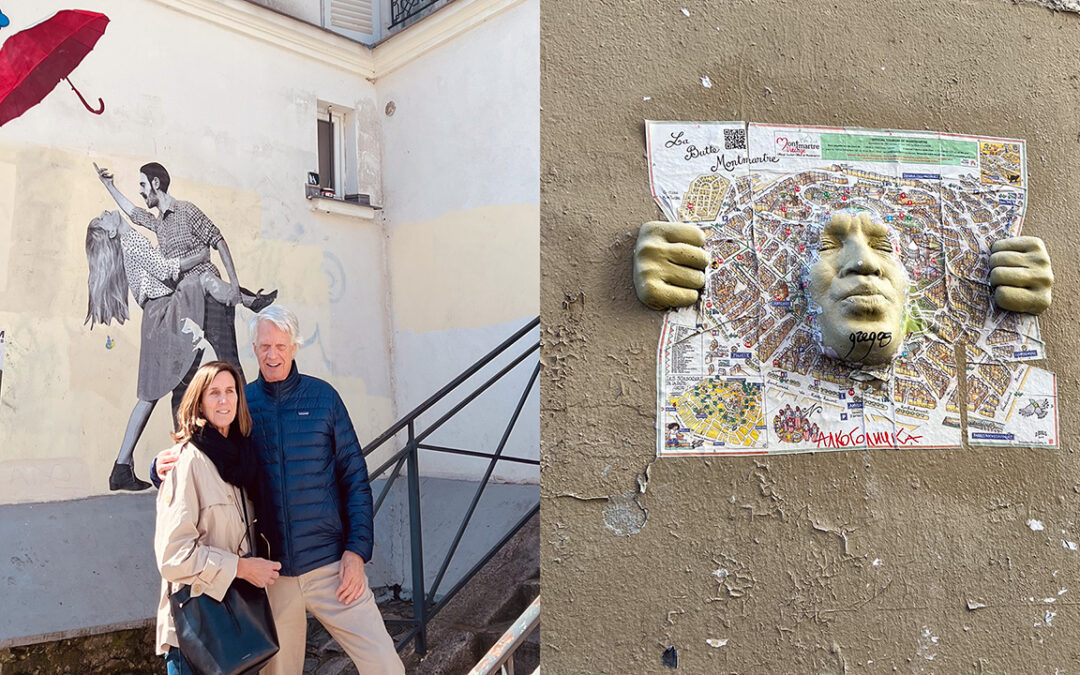
Anyway, just like last year, Susan and I will be sending back Parisian commentary and pictures to celebrate our spring time and hopefully brighten yours. À bientôt!
by Robert Bowie, Jr. | Mar 25, 2025 | Featured, Humor, Poetry
If you’re like me, the best memory you ever have had is an act of self-deception that you can’t remember. However, if you happen to stop forgetting for only a fraction of second it will be abrupt recollection.
It is like if you have ever accidentally slammed a door in your own face. It’s not easy to do, but you’ll remember it if you succeed.
On the first day of spring this year, I had one of those abrupt remembrances.
My New Year’s resolution this year is to get into better physical shape this spring. Unconsciously, of course, I have been getting less and less inclined the closer I get to springtime when I must start fulfilling my commitment to myself.
The truth is this New Year’s resolution has been the same New Year’s resolution I have made each year for over 20 years, but each previous spring I had successfully forgotten that years’s resolution.
Then I stumbled upon one of the sonnets in the book I wrote more than 20 years ago, entitled “Marathon Man.”
This year the door slammed in my face. Coincidentally, it occurred on the first day of spring last week, at a doctor’s appointment when I was told I must start exercising. I had forgotten that over 20 years ago I wrote “Marathon Man.” which made it much worse.
It starts:
The Marathon Man
“In a world of educated guesses
About one’s loves, integrity and health,
It is my custom to keep promises,
Even if they are only to myself.”
This is the perfect example of delusions of grandeur, which I had pleasantly forgotten into a magnificent memory of never committing to exercise, which is regrettably false.
As early as I can remember, I have consistently joked that I was so lazy I played goalie in all sports to avoid running laps. (The coach always shoots on the goalie while the rest of the team runs laps.)
But in my defense, technically being a goalie is not about the commitment to never exercise. It is a commitment not to exercise that I practiced religiously. I never committed to exercise. That’s entirely different.
Nonetheless, I’m highly competitive.
My memory is that I have saved myself from exercise to avoid injury so I will be ready for the senior Olympics when some doctor finally tells me I must exercise.
I have been told this before over 20 years ago when I was the marathon man but still as lazy and competitive as always.
Back then, I challenged a friend who is a very good runner to a 10 K race, but I got a 10-minute reduction of my time as a handicap to even the odds. For about three weeks before the race, I committed to run a mile around the high school track and, as a further commitment, I would eat four raw eggs poured out of a blender because I had seen “Rocky” the movie and Rocky did that.
It didn’t go well, which led to the delusion of grandeur in the form of a marathon. As is indicated in the third stanza:
“I trained on a treadmill, March to July.
Got my first runner’s high at 55.
Depleted my life‘s endorphin supply,
and blew out both knees and begged to die.“
So this time the doctor prescribed a certain number of steps as a target for each day. The doctor reminded me hopefully that it would also get me outdoors and into sunlight neither of which happened.
At the end of every day around midnight, before bed, I would find myself doing endless laps around the dining room table to meet my minimum requirement of steps.
Covid helped me along. My wife, who exercises regularly, proudly told me one evening her total steps and asked me about mine. I had decided to take the day off, so I happily worked and read pretty much all day. My total step count was around 50. Which probably is two trips to the bathroom and one to the kitchen.
Then I ran into this damn poem and I don’t feel good about getting ready for the senior Olympics. I feel my lethargy has not sufficiently ripened.
The sonnet ended with this final couplet:
“Oh yes, but the hell with all this fun;
Next year, for sure, I’ll be ready to run.”
— “An Accidental Diary: A Sonnet a Week for a Year” by Robert Bowie, Jr.
https://a.co/eg2uDCx
That was 20 years ago. No escaping it now. The door slammed in my face.
I guess I better go try to find my shoes.
by Robert Bowie, Jr. | Mar 18, 2025 | Featured, Humor, Personal, Travel
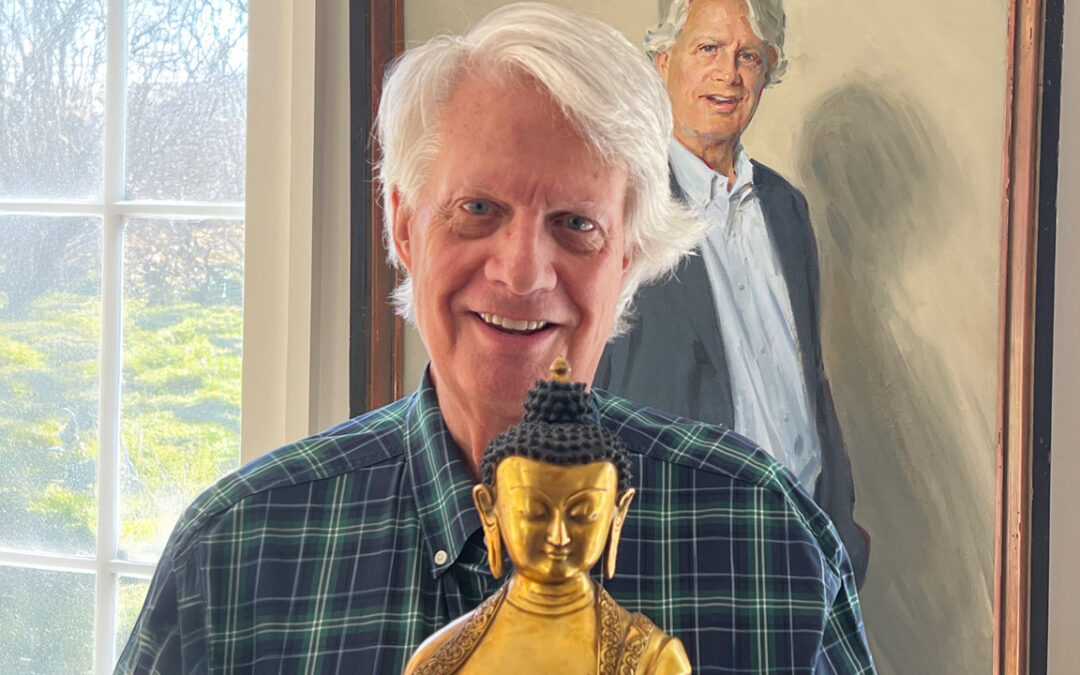
In Buddhism, there are instances of instant enlightenment brought by shock or surprise.
(I feel it is okay for me to comment on Buddhism and its wisdom as long as I admit to you that I know nothing about it.)
Nonetheless, I offer an example:
There are instances where a monk will slap a student of Buddhism to surprise them or shock them into enlightenment.
I have always worried about this experience of receiving shock and resultant enlightenment ever since I may have accidentally shocked some Buddhists out of their enlightenment.
It all occurred in the second floor men’s room of The Charles Hotel in Cambridge, Massachusetts.
Many years ago, I took a morning plane to Boston dressed travel casual, with my blue suit, white shirt, tie, black socks and black lace-up shoes in my suitcase. I was to attend important meetings that afternoon in Cambridge.
When I got to The Charles Hotel in the early afternoon, I was informed my room was not ready. I had nowhere to change into my suit.
I was told the delay was because the Dalai Lama and his large entourage were staying at the hotel. The Dalai Lama was there to plant a tree in Harvard Yard with the Harvard president and then scheduled to go off to Foxborough to give a message to the masses in the football stadium. Apparently, the hotel was behind schedule because of these new guests.
Since I couldn’t get into my room, my only alternative was to go to the second floor men’s room of The Charles Hotel with my suitcase and haul it into the handicap stall of the public men’s room, where I would have enough room to change.
I put the suitcase on the toilet seat and began to disrobe and change into my business attire.
I hung my suit on the back of the stall door, unpacked my black shoes and pulled out my dark socks, and was starting to put on the white shirt when I heard the unexpected sound of chattering female voices exploding into the men’s room.
There seemed to be a great urgency and effort to bring in two people who were in wheelchairs. One, a very old woman and the other, a very old man. These voices were not in English.
I stood there, stunned with my suit pants in one hand and a black sock in the other and stood listening. It sounded like a kitchen in a busy restaurant.
I tried to peek through the crack in the door, but only saw a flurry of female activity. All I could make out was at least one person, perhaps more, had an urgent need to go to the bathroom.
I waited patiently with my sock and my pants, but nobody was leaving. It was as if everybody, male or female, had to urgently go to the bathroom.
I waited for nearly 10 minutes, but I was late for my meetings, so I had to make a decision about what to do.
I quickly dressed and repacked my suitcase. I decided to open the door and just march straight through this mob of people.
Given the circumstances, this was a very rude thing for me to do, but given the fact that I was in a men’s room, I felt entitled.
With my suitcase in one hand, I pushed open the door and confronted the group.
Instantly, there was stunned silence and, as if my mind were a flash camera, I had a mental picture of as many as 20 colorfully-dressed people staring at me with their mouths open.
There were people staring as they stopped washing their hands. There were people staring as they stopped midway through entering or exiting a stall. Everything was frozen.
Then there was a collective gasp. Not a shriek or anything, just a gasp. I tried to pretend I was invisible as I barreled toward the exit with a sea of bright colors parting on both sides.
I may have caused significant damage. Or, possibly, I shocked some of the entourage into a different vision of enlightenment.
First, it was clearly an emergency of some sort. Somebody had to really go to the bathroom badly and I fear it was an old person.
Second, these were elderly people in wheelchairs and I am not handicapped but I was in a handicap bathroom.
Third, and finally, I consider myself a very sensitive person but even if I had no empathy at all, one must consider reincarnation in all of this.
I offer no excuses. I think there may have been damage done to me, as well. I’m certain my karma is permanently shot. If there is reincarnation, I shudder to think what I will come back as.
So I’ve confessed it. I will also confess that I’m a believer in the “butterfly effect,” which is that every action causes a ripple across the universe.
If anything good comes from this, it is simply that I can warn you to be careful if you run into a similar situation.
You never know when a cosmic event will hit you.
by Robert Bowie, Jr. | Jan 21, 2025 | General
I am an American, who loves our country, but hates its present polarization. I have not written about politics over the last several months because I have been putting together and marketing my book “The Older You Get the Shorter Your Stories Should Be.” However, any chance at humor will break down my resolve to avoid politics and be politically incorrect.
Today I couldn’t resist the humorous head-on collision of President Trump being sworn in (without his hand on the Bible) at the same spot where almost 50 years ago, Jimmy Carter, a devote Christian, was sworn in as our 39th president. But it got more ironic after Donald Trump was sworn in where four years before he had led an insurrection to overthrow the election that he had lost and, within hours after being sworn in, signed an executive order releasing 1500 people convicted of the insurrection. It made me laugh to think of poor Jimmy rolling over face down, as he lay in state.
Of course, my observation was random this morning because I had been randomly leafing through the section of the book entitled “It Can’t Happen Here” and found, on page 159, “Back to the Future.”
What made me laugh and write this now was a feeling of claustrophobia, which made no sense. I know this is dark and perhaps inappropriate, but we still have to figure out how we can all laugh together again at the absurdity of all this irony.
—
Back to the Future
Last month I took a trip because I wanted to “feel” what it was like to live in WWII Germany and the Soviet Cold War occupation in Czechoslovakia and Poland.
I already knew the dates, places and times from textbooks, but it’s quite different to experience what it was like to have lived during those times.
Of course the trip would come alive in museums and, unexpectedly, it brought back for me a long lost feeling I had years ago when I was just a young boy. I had gotten lost off shore in Buzzards Bay in a small motorboat that was running out of gas on an outgoing tide in thick predawn fog.
It is odd how we learn through memories and association.
How odd that museums, which were about imprisonment, brought back the feeling of drifting out to sea, creating an odd claustrophobia without barriers other than an endless borderless fog.
The claustrophobia slowly kicked in when I visited Checkpoint Charlie, the famous heavily guarded passthrough in the Berlin Wall, which kept the East Germans imprisoned inside.
It started with a set of pictures of a boy who had scrambled to climb the wall in an effort to live in freedom, but the photos chronicled how he had died riddled with bullets, hanging from barbed razor wire near the top of the wall.
How odd that I could feel claustrophobic under wide-open skies?
A few days later, the claustrophobia increased in one of the East German museums that focused on the Nazi SS and their little gray bread trucks. These had no windows, just a sliding door on one side and three closet-sized cells so small that prisoners could not stand but only sit in a narrow chair, hands by their sides, while they were taken to a concentration camp somewhere outside of Berlin.
A few days later as we traveled toward Prague, we stopped at another prison that was three or four stories high with interrogation cells on the top floor. The inmates who would not answer were showed pictures of their family who would be killed if they continued to resist.
Putin had spent six months in the house across the street when he was in Soviet intelligence, attempting to flip the tortured inmates to become Soviet spies.
The claustrophobia wrapped around me in that silent building when I realized what it must have felt like day and night in there. It was missing the noise of slamming cell doors, the echoing screams and the smell of the single bucket in the corner, which acted as a bathroom in each cramped cell, with three to a single bed and no mattress.
I know now why the feeling I had on this trip was claustrophobic but I thought it was still an odd reaction to the history of the past until I realized I had lived my whole life free in a democracy.
All of a sudden, I felt imprisonment under borderless wide open skies as a psychological imprisonment which became unbearable.
All of a sudden, I could feel the last breath of the boy crucified and bleeding from razor wire on the top of a Berlin Wall as a reaction to my claustrophobia and his death.
Years ago, as I slowly ran out of gas in my little boat, I saw the outline of a cliff as the late morning fog broke. There were connected ladders and a climbing set of stairs. I beached the boat and climbed to the top of the cliff and knocked on the door of a little cottage overlooking the ocean.
A woman with the Sunday newspaper tucked under her arm answered the door. I breathlessly asked, “Where am I?” She looked at me quizzically and answered “Menemsha,” then paused, “Martha’s Vineyard,” and then paused again… “The United States of America.”
I remember feeling happy and alive.
—
My only hope is that we can end this polarization with the brilliance of our democracy as we go into the future.
by Robert Bowie, Jr. | Jan 15, 2025 | Featured, Humor, Personal
At 8:30 pm, kickoff time last Saturday night, it was four degrees below freezing but that didn’t bother me because I am still a young man and invincible. The truth is I was probably the oldest geezer at this playoff game at Ravens Stadium that night.
The only concern I had was how many layers I needed. I figured about three or four layers would keep me warm. I put on hiking boots, double socks, old long johns, regular zip-up khaki pants, zip-up snow pants with a snap at the top to hold it all together and then, above the waist, two parkas layered on top of each other, and my Ravens’ Ray Lewis jersey, then finished off with thick gloves and a hat that I could pull down over my ears. I probably looked like a Michelin Man moments before a career ending explosion.
As I dressed for the game, it never occurred to me that this might be absolutely the coldest I wiould ever be in my whole life.
Susan and I have compiled six season tickets on the rail at the corner of the end zone. These tickets are great because they are so close to the field it is like watching high school football.
I bought the tickets over 20 years ago when my son, age 12 and under five feet tall, announced he wanted to be a quarterback and begged me to get us Ravens tickets, which I did.
Of course, as soon as I had purchased the tickets, my son asked my assurance that if, per chance, the Ravens went to the Super Bowl we would also go to the Super Bowl, to which I agreed.
Even the Las Vegas odds makers were good with that bet. Much to my horror, that year we went to the Super Bowl and I found myself behind a 711 in a dark parking lot peeling off $100 bills to get tickets to Tampa Bay where the Ravens would beat the New York Giants.
Nonetheless, in the first game of that very first season, way before that Super Bowl, we met lifelong friends who would occupy the seats behind us. The father sat right behind me on the aisle and, next to him, right behind my son, was his son Derek, who was several years older than my son. Derek listened to the game with a headset while we all watched live. The first play there was a whistle blown, and all the people behind us burst into rowdy inquiries about what the hell was that whistle for.
My son, already a scholar of the game, immediately turned around and answered: “The quarterback took a step before the snap.” Instantly, the stadium announcer repeated the exact same words my son had said, as did the announcer on the radio, which Derek then quoted. From the beginning, Derek, his father, his family, and Rick and I became friends and have remained friends ever since. Derek, from the start, was a fact checker and reserved, thoughtful observer.
During the regular season, we give the tickets to our children and watch the games on TV. However, if the Ravens got into the playoffs, you gotta go!
So that’s how I got to see Derek again for the first time this year at Saturday’s playoff game. Everybody was bundled up, but the hugs and the high fives were everywhere as the stadium filled and became more and more raucous.
Despite my layering, I started to get cold as soon as I got out of the car. We had about an eight-minute walk to the stadium. I proved to myself what I had often heard, that you lose 30 percent of your heat from the top of your head, so I pulled the hat down over my ears as I plodded toward the stadium.
I was shaking with cold by the time we reached our seats. I wanted to take pictures with my phone but I had to take off my gloves first. I had no place to put my gloves so, finally, I tucked them into my hat and put my hat back on. Then I started to shake and the hand warmers fell with my gloves, onto the field. After my gloves were returned to me, my hat fell off onto the field, and that had to be returned to me as well.
By halftime, my feet were freezing and I had to go to the bathroom to try to warm up. There was a line in front of the stall where I had hoped to strip off each one of my three layers in order to be able to stand and deliver in front of the toilet with privacy. But because the line was too long, I had to strip down in front of one of the many urinals, and so a crowd watched me slowly disrobe as I tried to unzip three sets of zippers and drop my pants. That took some time, but it got much worse when I tried to pull the three layers back up, because the long johns’ old elastic waist belt had deteriorated and broke so I developed “droopy drawers.”
In order to re-dress myself, I had to move out of the way of others who wanted to use the urinal, so I stood in the middle of the floor with a bank of urinals on either side of me as football fans with beer-loaded bladders filed in, looking at me as I tried to zip up and button up and pull up my pants as they passed. The button snap at the top of the snow pants was an Olympic event.
By the time I reached my seats again, the roar in the stadium had continued to rise so nothing could be heard except the screaming of the crowd. Derek was screaming at the top of his lungs and had moved from his aisle seat down to stand next to me at the rail. The place was insane.
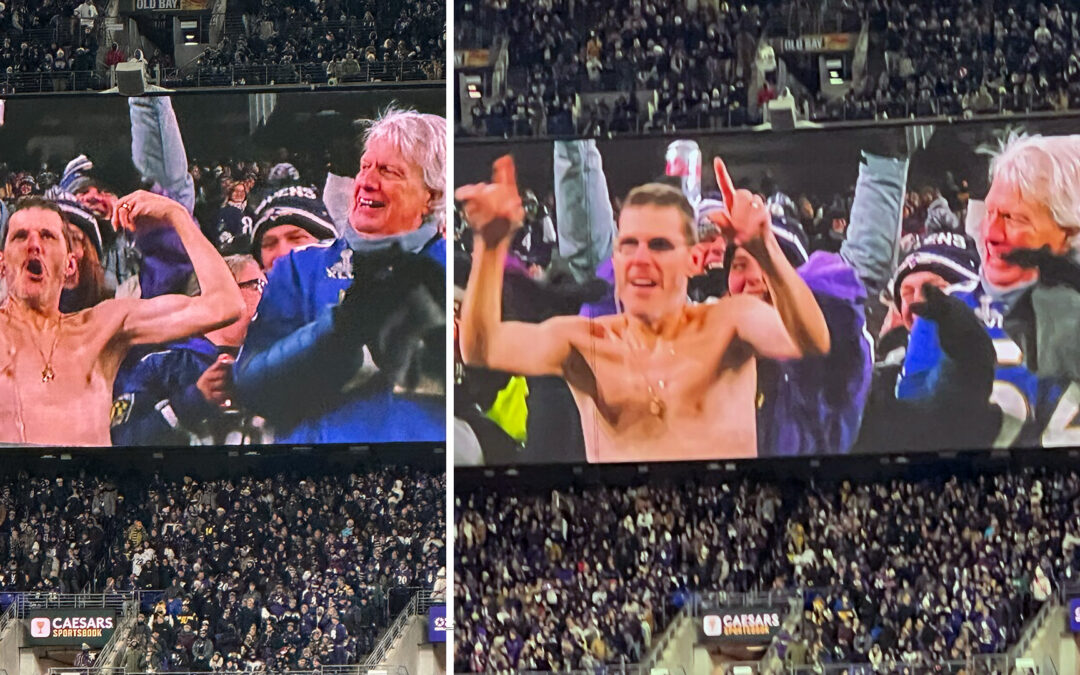
At the other end of the stadium, in the second balcony, a man started ripping off his shirt and started spelling out R-A-V-E-N-S, bare chested, and the stadium burst into cheers and chanted the letters. Then, of course, his entire performance was being performed on the Jumbotrons at both ends of the stadium.
At this point, I was convinced if I thought about how cold I was, I would give my brain frostbite.
I clenched my whole body to try and keep warm. Then there was an explosion of noise all around me. Why was everybody shouting around me and pointing at Derek?
Derek, who had always been reserved, was upstaging the guy at the other end of the stadium, and was now ripping off his shirt to the delight of the crowd. As I was freezing to death, Derek was getting naked on the Jumbotron.
If it takes a village to raise a child, it apparently takes a football stadium to mature a geezer.
I’m not quite as upset that the Ravens’ next game won’t be at home, and I’m certainly not going to Buffalo. If I don’t get pneumonia from the postseason, I’m planning to go to the first preseason game in late August — in shorts and a Ravens T-shirt.
Life has always been good to me as a slow learner. I finally threw away the snow pants with the broken elastic belt.
by Robert Bowie, Jr. | Dec 24, 2024 | Featured, Personal, Poetry, Shorter Stories Book
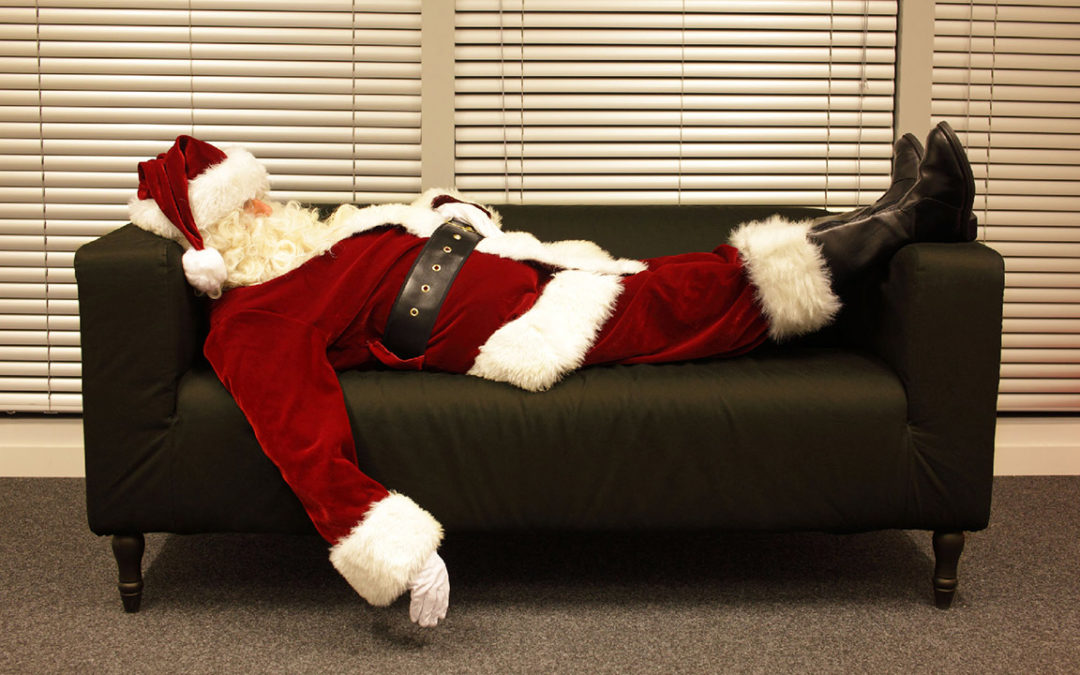
Once upon a time… I was in a Rotary Club that was going to sing Christmas carols at an old age home, but because I couldn’t sing or dance, I had to be Santa. I had to wear a huge red Santa suit, and a big grey beard that hooked behind my ears, install two king-sized pillows into my new jolly belly and then keep it all together with a big black belt to hold my pants up.
It took a long time to assemble Santa, so I dressed at home and drove in my little BMW Z3 convertible to the event. I’m a good driver, but I was listening to Jingle Bell Rock or the Chipmunks or something and I found myself as the last car in the middle of an intersection trying to turn left into an old age home as the light changed. All of a sudden, there was loud honking as traffic passed in front of me and behind me as I spread Christmas joy throughout the intersection.
It was a pretty long light, so I got a lot of attention from the Santa-stalled traffic. Everybody was honking at me and children were laughing and waving at Santa from the backseat in the slow moving cars that went past me as the traffic jam spread like a stain in all directions. When the light changed, the last car to get past me gave me a Merry Christmas two-fisted finger and stopped in front of me and leaned on the horn as we spread our joy of Christmas in all directions.
That is the exact place. The “when” and “where,” the “place and time” I lost my Christmas spirit those many years ago.
It’s not come back yet. Someday I may want to be Santa again, but not yet. I still have Santa PTSD but I’m working my way through it. I try to think about happy things as I fight to regain my real inner Santa. I imagine I am taking a warm shower:
Santa
Like a massive multicolored parachute
His boxers have collapsed upon the floor
Slightly south of a wrinkled Santa suit
That was left just outside the bathroom door.
A bunch of imagined elves in repose,
Smokin’ cigarettes, feet on the table,
Hangin’ and laughin’ ’bout Rudolf’s nose
Are lovin’ life as only elves are able.
Another Christmas is, at long last, past
As the fat man shampoos in the shower
And thinks of golf and summer thoughts at last.
Who’s this metaphor for redemptive power?
An old fat guy driving a sled with gifts?
A father at midnight is what it is.
——
If you are like me and somewhere, perhaps in some random traffic jam, you also lost your Christmas spirit, here is Santa’s two-step solution:
First, seriously get over yourself and just do something nice for someone else. I’m serious about this! It can be nothing but a random act of kindness but make it happen. You will be amazed at what will happen. It will rekindle that lost Christmas spirt. Don’t expect anything in return.
…And second, when you are asked who gave you this advice, straight out tell them, without hesitation, that you got the advice from Santa. There’s a pretty good chance you can share a free Christmas dinner in some state institution.
Merry Christmas and Happy Holidays from me to you. Peace on Earth! Make it happen with random acts of kindness while expecting nothing in return.
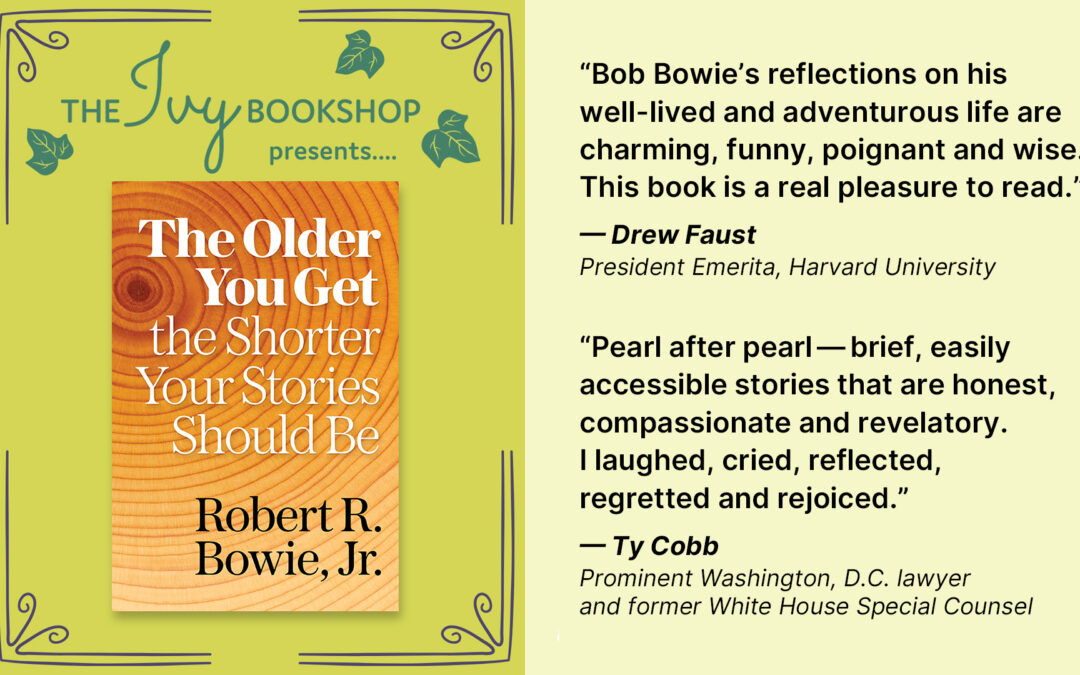
P.S. A little side note: If you want to make commercial Santa’s Christmas, you can buy his book, An Accidental Diary: A Sonnet a Week for a Year on Amazon. Or maybe pick up his new book, The Older You Get the Shorter Your Stories Should Be at The Ivy Bookstore in Baltimore, The Manner Mill in Monkton, Maryland, or at https://bookshop.org/shop/robertrbowiejr)
by Robert Bowie, Jr. | Dec 3, 2024 | Featured, General, Personal, Shorter Stories Book, Travel
If you’re tired of Black Friday, Small Business Saturday, Cyber Monday, and Gift Return Tuesday, I have an alternative for you that will make you laugh.
First, I bet you that you have never been as embarrassed as I have been. If you start laughing as you read this story, continue on to get a reward after you’ve finished reading.
The Story:
You think you’ve been embarrassed? Well, I’ve got you beat.
First, it all happened to me on the other side of the planet so I couldn’t go home, turn off the lights and put my head under the pillow.
It happened in Xi’an, China, in an airport the morning I was scheduled to fly to Chongqing to see a panda sanctuary, then board a boat to go down the Yangtze river through the Three Gorges, and then down to Shanghai.
Second, I was traveling with a small group and the Xi’an Airport was huge, so I had nowhere to hide as my embarrassment went on and on and on…
It all started innocently at dinner the night before we were scheduled to fly out of the Xi’an airport the next morning. Our guide addressed the group and informed us that because our plane left so early the next day we all must have our bags packed and outside of our door at 4:30 so they could be picked up and taken to the airport before we went to breakfast.
Everything had to be packed except the clothes we would be wearing the next day and whatever toiletries we required for that morning.
We were told that those toiletries, once used, had to be carried on our person until we landed at Chongqing airport several hours later at which time we could return them to our suitcases.
After dinner that night, we all went up to our rooms, picked out the essential toiletries, which in my case was toothpaste, toothbrush, shampoo, razor, soap, and hairbrush. I also chose my clothes for the next day, which in my case, were one of my endless pairs of khaki pants, a blue long sleeve business shirt, underwear, sox and shoes.
All the rest was packed in the suitcase, which I put outside the door right before I set the alarm and went to bed.
The next morning when my alarm went off, before I showered and shaved, I peeked out the door. My suitcase was gone and on its way to the airport. I looked at the clock and measured the short time I had to get to breakfast.
After my shower, I bundled up my toiletries, put on my blue business shirt and started to pull up my khaki pants, but couldn’t understand why I couldn’t get them on until I realized that the only pair of pants I had to wear were actually those I had mistakenly packed, which unfortunately belonged to my teenage son.
My son has a 32-inch waist. I do not.
I was running out of time. I had to get to breakfast.
I grabbed both sides of the pants so that my fingers gripped the pockets and I hoisted as hard as I could. No progress.
Next, I lay on my back on the bed with my feet extended in the air and bounced on the bed to get maximum leverage, kicked my feet into the air and yanked with all my strength. No progress.
The top of the pants made it to maybe slightly above my crotch. I’m pretty certain I did not get the pants high enough to halfway cover my back end. Nothing.
Next, I tried straddling a chair and forcefully rode my pants like a cowboy rides a horse in order to force the crotch into submission. I then tried jumping up and down to get maximum thrust, lift and torque. Nothing. This was not good!
I had to get to breakfast but I couldn’t leave the room. This was not good at all!
I reassessed my situation.
I still had to put on my shoes and socks. I would have to roll up the bottom of the pants so that I wouldn’t trip over them.
I was able to walk, but only if I could hold the top of my pants up as high as possible, and walk with my knees banging together every time I took a step.
I searched the room for any possible help. I was fortunate to find yesterday’s Chinese newspaper — bright with color — to cover my crotch.
It was a very long and slow elevator ride for every inch of the decent down maybe three floors. I noticed that the Chinese people in Xi’an, at least in this elevator on this particular morning, tended to be very quiet as they tried to find someplace else to look other than at my crotch.
My group at breakfast was less forgiving. They had to stop eating because they couldn’t stop laughing.
Our guide tried to be helpful and encouraged me to wander the airport to find a clothing store, apparently in the hope that I could learn Mandarin instantly and acquire a pair of pants that was twice the size that any self-respecting member of the culture would never wear.
The guide was just trying to be helpful I know, but didn’t seem to understand that I was really, at this point, no longer interested in clothing. I was no longer hoping to fit into the culture.
I was hoping to vanish from the face of the earth.
Everyone in the airport seemed to be walking by and rubbernecking in order to catch sight of whatever everyone else was laughing at.
I was completely hunched over, gripping my newspaper and pants, with my pant legs rolled up above my ankles and, just to add to my unlikely assimilation into the culture, I was wearing my disposable razor, shaving cream, toothbrush, toothpaste and hairbrush bundled up into a boutonniere blooming from my shirt pocket to add to my look.
The Chinese newspaper was fast becoming my most valuable asset since, as it turned out, my seat on the plane was between two meticulously dressed, very frightened Chinese businessmen who apparently feared any eye contact with me, their fellow traveler, for fear that it might prompt me to flash them.
In times like this I try to focus on making my situation into a positive learning experience.
After thinking about my situation for a little while, I concluded there wasn’t a lot to learn so, in the alternative, I thought it might be helpful to try to imagine what could be worse than what was happening to me at this exact moment.
I no longer wonder what it must feel like to wear a miniskirt if you are knock kneed, but that wasn’t bad enough, so I tried to imagine what it was like to wear a miniskirt, knock kneed with high heels.
I made sure that I would be the last person to leave the plane when we landed. in order to give the baggage handlers extra time so when I went to pick up my bag it would be there.
I hid in the airport men’s room for a while. I was afraid I had permanently injured my lower intestines. I was sure I had bruising. I couldn’t really lift or lower my pants now.
Eventually, I built up all my courage and raced through the teeming airport hunched over, with one hand holding the top of my pants and the other gripping my newspaper.
I swooped down on my bag and hauled it into the men’s room, found a stall, opened the suitcase, liberated myself of my son’s pants, and instantly threw them away for no good reason other than I needed to purge them.
A few months ago, I went on a trip with some of that same group that had gone on the China trip. When my story came up, I refused to relive the experience, so they went right ahead and told it anyway. They kept on embellishing the story at my expense.
The trip to China was 10 years ago, and the listeners could not stop laughing. Apparently, it gets better and better.
One person, who I am not sure was even on the China trip, claimed to have seen it all from the back and referred to it as “the morning the moon rose over the Yangtze!”
I must now live in infamy forever.
—
The Reward:
Good for you! You laughed. You are honest because here you are and so you deserve a reward. Now that you’ve laughed you don’t feel quite as bad about not completing your holiday shopping on Black Friday do you?
So here is your reward.
You will be pleased to learn all your remaining shopping can be completed for everybody left on your list, including stocking stuffers!
That story, which you just read, about my “streaking” through China is the very first story in my book, The Older You Get the Shorter Your Stories Should Be, which is now available at The Ivy Bookshop, The Manor Mill, Porter Square Books, or you can order from Bookshop.org (https://bookshop.org/shop/robertrbowiejr) or Amazon.com, where there’s even a Kindle version now! Or you can ask your any book store worldwide to order it using the following ISBN: 978-1628064209.
In addition, this book is perfect for regifting. Buy a copy for yourself. Tell your second recipient that you’ve road tested it because you care so much for them.
Finally, all the stories are short and perfect for your friends and family with short attention spans and they are great for deliberate bathroom reading and, of course, if you buy lots of copies you will make me really happy, too.
